 |
| French EP(October 1960). |
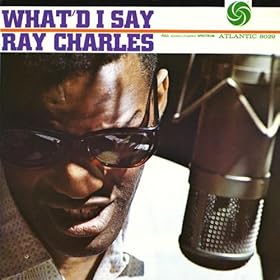
Compilation album: What'd I Say. Atlantic 8029, September 1959.
Recorded on 11 September 1952 in New York.
The musicians remained uncredited.
Mediagraphy - Discography - Trackography - Videography - Gigography - Biography - Chronology
|
| French EP(October 1960). |

 Single (A/B; Part 1/2) Atlantic 2006, October 1958.
 Single (A): Atlantic 2010, November 1958, b/w (The Night Time Is) The Right Time.
 Single (B): Atlantic 2022, April 1959, b/w That's Enough.
 Single (A): Atlantic 2022, April 1959 b/w Tell Me How Do You Feel.
 Single (B): Atlantic 1172, January 1958, b/w Talkin' 'Bout You.
 Atlantic vault's single masters #3263, 3264:
Each Monday of this year, we bring you a story on the best American music of the 20th century, the NPR 100. Today a song from Ray Charles, the song he's been closing his act with for 40 years. In his words, 'A stone-cold rhythm and blues song' called What'd I Say.
One night when he was touring in the summer of 1959, Ray Charles was on stage and out of songs and it wasn't time yet to get off stage. [In an interview with his biographer Michael Lydon, Charles placed the event in December 1958, at a club in Brownsville PA]. He started improvising at the piano and told his band and backup singers to follow his lead. The crowd loved it, so he kept playing that song night after night.
Mr. Ray Charles (Musician): I had called Atlantic Studios and I said, 'I'm playing a song right here on the road, and I don't know what it is. It's just a song I made up but the people are just going wild every time we play it and I think we ought to record it.' And they said, 'Well, come on in to New York and let's do it.' And I did it, and that was it.
Mr. Charles: I started to play dune-do-de-dune-dune, dune-do-de-dune-dune, but that was on a little, small, tiny electric piano and of course the musicians used to laugh at me and used to say, 'Oh, man, what are you going to do with that toy?'
SIEGEL: Well, electric pianos at that time were still fairly exotic.
Mr. Charles: That's right. Well, I told you everybody was laughing at me; asked me when I did that, 'Man, what are you going to do with that little bitty thing? That thing can't do nothing. Man, you need a piano.' But I liked the sound of it, and we did it and I think that's really what's strange with that little bitty piano. That's what really captured the public's attention, was that dune-do-de-dune-dune, dune-boomp-be-doom-boom. You know what I mean?
Mr. Charles: Hey, Mama, don't you treat me wrong. Come and love your daddy all night long. All right now. Hey, hey. All right. See the girl with the diamond ring? She knows how to shake that thing. All right now, now, now. Hey, hey. Hey, hey. Tell your mama, tell your pa, I'm gonna see you back to Arkansas. Oh, yes, ma'am, you don't do right. Don't do right. Oh, play it, boys.
Mr. Charles: I have to tell you, Robert, the song in itself, it has no meaning, and I'm talking about my own song but I'm being honest about it. What I mean by it, you know, if you listen to the lyrics, you'll discover that each verse does not match the next verse. I just put a lot of verses together. `See the girl with the red dress on,' and the next thing you got `See the girl with the diamond ring.' It makes no sense.
Mr. Charles: See the girl with the red dress on? She can do the Birdland all night long. Yeah, yeah. What'd I say... You can tell it was a made-up song because the verses, as I say, don't match. But I think what was important about the song was not so much the verses but I think it was the beat. I think that's what got people.
SIEGEL: Yeah. Well, draw a picture for us here of what was going on at the moment when the song seems to end, and then there's this banter among everybody who's in the recording studio.
Mr. Charles: Oh, that was something that we made up in the studio, and what we decided - we said, 'Well, look, when we play this song all the way through with my singing and we stop, I want you guys to act like you don't want me to stop.' You know, I said, 'Just say hey, what are you doin', man? You can't stop.' You know, and everybody's talking at the same time. But that was by design, because in those days, you know, you had part one and part two.
SIEGEL: Yeah, you wanted to have a part one and part two...
Mr. Charles: That's right.
SIEGEL: ...in part because radio stations wanted to play songs that ran about two and a half minutes.
Mr. Charles: Yeah, that's right. See, you're absolutely right. You see, in those days, you know, you did anything past three minutes, man, you were in trouble.
Mr. Charles: Baby, I want to know, yeah.
Unidentified Group of People: ...(unintelligible). Come on. Come on.
Mr. Charles: No, I can't.
Unidentified Woman: Play it. Don't stop. Do it again.
Mr. Charles: Wait a minute. Wait a minute.
Unidentified Woman: Play it.
Mr. Charles: Wait. Hold it. Hold it.
(Singing) Uh.
Unidentified Group of Singers: Uh.
Mr. Charles: (Singing) Oh.
Unidentified Group of Singers: Oh.
Mr. Charles: (Singing) Uh.
Unidentified Group of Singers: Uh.
Mr. Charles: (Singing) Oh.
Unidentified Group of Singers: Oh.
Mr. Charles: (Singing) Uh.
Unidentified Group of Singers: Uh.
Mr. Charles: (Singing) Oh.
Unidentified Group of Singers: Oh.
Mr. Charles: (Singing) Oh, one more time.
Unidentified Group of Singers: Just one more time.
Mr. Charles: (Singing) Baby, one more time, baby.
Unidentified Group of Singers: Just one more time.
Mr. Charles: (Singing) Just one more time...
I have to be very, very honest with you, I was very surprised. It was very strange that most stations played the whole thing from start to finish.
SIEGEL: Hm.
Mr. Charles: You know, very few stations broke it up like it was supposed to be.
SIEGEL: By the way, what is it that the girl with the red dress on can do all night long, exactly?
Mr. CHARLES: She can Birdland all night long.
SIEGEL: She can Birdland?
Mr. Charles: And then I said, 'See the girl with the diamond ring? She knows how to shake that thing,' which got me in a lot of trouble.
SIEGEL: Yeah. Yeah, this song did get you in some trouble.
Mr. Charles: Yes, it did. Well, you know, when we did it, a lot of people were saying that it was too suggestive; you know, there was a part in there where I said, 'Oh, oh, oh, ah.' And they said, 'Oh man, oh no, we can't put that on the radio 'cause, I mean, it's' - you know, I don't know why but for some people - just my saying that bothered some people.
SIEGEL: Well, you have to admit, it is pretty suggestive.
Mr. Charles: Yeah, well...
SIEGEL: Whether it should be on the radio or not is another matter.
Mr. Charles: Well, I look at it this way, Rob. I figure it this way: It depends on where your mind is. It's like the saying, 'Bees do it, birds do it, even educated fleas do it.' Now where's your mind going to go with that? You see, it's all the where the mind wants to take you.
SIEGEL: But this song, as you say, this is not a great lyric.
Mr. Charles: No.
SIEGEL: This is about the rhythm, this is about the beat of the song. And it must have been great hearing you when you were first playing this in clubs, even before it was on records, would people - in addition to your own singers - would people in the club get into it and sing with you?
Mr. Charles: That's right. That's right. Well, see, the people can get into it 'cause when I say 'Oh,' everybody can say 'Oh.' Everybody can do that. They can say 'Oh, oh, oh, oh,' and they like it, you know? And it's fun for me because I love to see people enjoying themselves, you know? What we wanted to do is to build the people up, you know? You start 'em off and, you know, you get 'em just first tappin' their feet, and next thing they got their hands goin'. And then next thing, they got their mouth open and they're yellin' and they're singin' and they're screamin'. And, you know, it's a great feeling, you know, when you can have your audience get involved with you. Now that don't mean you want them involved in everything you do, but it's nice to have a little something, you know, in your show where everybody can just jump in and have a real good time. And that's what you want, because "What'd I Say" is my last song on stage. When I do "What'd I Say," you don't have to worry about it; that's the end of me.
SIEGEL: You mean is that it, you're exhausted after doing it?
Mr. Charles: Yeah, that's it. When you hear "What'd I Say," you don't need to worry about it. There ain't no encore or no nothing. It's finished.
SIEGEL: Well, thank you once again for talking with us.
Mr. CHARLES: Well, Mr. Robert Siegel, I've got to tell you, I'm going to keep on listenin' to you, OK? Is that all right with you?
SIEGEL: Well, I'm going to keep on listening to you, too.
Mr. Charles: Well, bless your heart. I love you, man. Take care of yourself.
SIEGEL: Thank you, Mr. Charles. Bye-bye.
Mr. Charles: Bye-bye.
SIEGEL: Ray Charles talking about his 1959 hit "What'd I Say," part of the NPR 100.
(Soundbite of "What'd I Say," by Ray Charles)
Mr. Charles: Wow, feel all right now.
Unidentified Group of Singers: Makes you feel all right.
Mr. Charles: Said I feel all right now.
Unidentified Group of Singers: Makes you feel all right.
Mr. Charles: Whoa!
Unidentified Group of Singers: Makes you feel all right.
Mr. CHARLES: Tell you I feel all right.
Unidentified Group of Singers: Makes you feel all right.
Mr. Charles: Said I feel all right.
Unidentified Group of Singers: Makes you feel all right.
Mr. Charles: Said I feel all right.
Unidentified Group of Singers: Makes you feel all right.Read this Wikipedia article for a reasonably accurate monograph on the song. For even more details on re-issues and remastered versions, see this forum thread.
 |
Promotion single (prod. by
Pony Canyon, SSP-98 - 1990)
for Suntory campaign. |

 |
| Liner notes (from UKrelease). |


The Ray Charles Video Museum is a research project, documenting live performances by The Genius.
This blog is above all a Mediagraphy. It's also a discography (or, more correctly, a trackography), aggregating all tunes that Ray sang and/or played - including the "canon" of 700 tracks listed on the official Ray Charles website, but also identifying the songs that have never been officially released, and e.g. the recordings of other artists, where Ray backed them on piano. Thirdly, this blog has evolved into a multimedia Chronology (click the years in the panel al the top of this page) of Ray's productive live.
I also try to do some justice to the more than 1,000 great musicians and singers who contributed to Ray's career (1, 2).
The Quotes page lists the wisest, craziest and funniest things that the Genius ever said. If you want to read more about Brother Ray, go here.
The availability of the streaming video and audio content on this blog is constantly under pressure. Some rights owners still think that sharing these videos damages their sales. I'm keeping disfunctional clips as placeholders - to show that the footage exists, and to replace them when new uploads appear on the Web.
The articles in this blog are continuously updated and improved. Your help is more than welcome.


 Posts
Posts

