 |
| I don't know of a Hammond with three keyboards... is this in a church or theatre? Location and photographer unknown. |
Showing posts with label Organ. Show all posts
Showing posts with label Organ. Show all posts
14 June 2018
Ray Charles, Playing A ???Hammond??? (Early 1960s)

20 November 2014
A Girl I Used To Know
Album: Ray's Moods, ABC/Paramount/Tangerine 550, 1966.
Recorded in August 1966 at RPM International, in Los Angeles.
With strings; a choir; Ray Charles - organ and piano; Rene Hall - guitar; Carol Kaye - bass; Hal Blaine - drums.
The live version, with The Raelettes and Billy Preston's pedal work on organ - was considerably better.
'68 LC Bluesthing:
Live:
Album 1968 Bluesthing - Released
18 November 2014
Baby Cakes (Ray Charles On Organ)
 |
| Ray's liner notes. |
Recorded at Ray's RPM studios in Los Angeles, on 24 November 1965. Ray played the organ.
Bobby Bryant (tp), Urbie Green (tb), Kenny Shroyer (btb), Jackie Kelso (as), Plas Johnson (ts), Jewel Grant (bars), Ray Charles (org), Mike Rubini (p), Rene Hall, Arthur Wright (g), Carol Kaye (b), Grady Tate (ds), Gary Coleman (perc). Quincy Jones (arr, cond).
15 November 2014
Chitlins With Candied Yams
Album: Ray's Moods, ABC/Paramount/Tangerine 550, 1966.
Recorded in August 1966 at RPM International, in Los Angeles.
Ray Charles - organ and piano; Rene Hall - guitar; Carol Kaye - bass; Hal Blaine - drums; The Raelettes - backing vocals.
Recorded in August 1966 at RPM International, in Los Angeles.
Ray Charles - organ and piano; Rene Hall - guitar; Carol Kaye - bass; Hal Blaine - drums; The Raelettes - backing vocals.
09 November 2014
Heaven Help Us All
Album: A Message From The People, ABC/Tangerine 755, April 1972.
Recorded at RPM International in Los Angeles in 1972.
Ray on piano, and probably also on organ. The musicians remained uncredited (but follow the link to the album to see a listing of identified session musicians).
Andy William Show, 1971 (with Andy Williams, Mamma Cass, Elton John):
Israel 1972:
Ettal 1976:
Live:
'71 TV Andy
'72 LC Tel Aviv - Released
'76 LC Ettal
Hey Mister
 Album: A Message From The People, ABC/Tangerine 755, April 1972.
Single (A): ABC 11337, November 1972, b/w There'll Be No Peace Without All Men As One.
Recorded at RPM International in Los Angeles in 1972.
Ray probably played organ on this track. The musicians remained uncredited (but follow the link to the album to see a listing of identified session musicians).
Live:
'73 LC Arbor
31 October 2014
Life Is Suicide (By Percy Mayfield, Ray Charles On Organ)
 |
| "Life Suicide". |
Single (B). Tangerine 927, 1963, b/w Never Say Naw.
Possibly the saddest sample of Percy's fantastic body of song lyrics.
Life Is Suicide Recorded in Los Angeles in 1962.
Percy Mayfield - vocals; Hank Crawford - alto saxophone; David Newman - tenor saxophone; Ray Charles - organ; Sonny Forriest, guitar. Arrangement by Gerald Wilson.
Lift Every Voice And Sing
Album: A Message From the People, ABC/Tangerine 755, April 1972.
Recorded at RPM International in Los Angeles in 1972.
Ray may have played the organ on this one. The musicians remained uncredited (but follow the link to the album for the identified session players).
The Raelettes contributing to the Cavett shows were Vernita Moss, Susaye Green, Mable John, Dorothy Berry, and Estella Yarbrough. All five, but surely the first four were also involved in the album recording.
Cavett 1972:
Live:
'72 TV Cavett
25 October 2014
My Jug And I (By Percy Mayfield, Ray Charles On Organ)
 Single (A): Tangerine TRC 957, 1965, b/w Give Me Time To Explain.
Album3: Percy Mayfield, My Jug And I, Tangerine TRC 1505, 1966.
Recorded in Los Angeles on January 20, 1964.
Percy Mayfield - vocals; Ray Charles - piano; Edgar Willis - bass; Other personnel unidentified. Arranged by Gerald Wilson.
22 October 2014
One Hurt Deserves Another (The Raelettes, Ray Charles On Organ)
 Single (A): Tangerine 972, 1966, b/w One Room Paradise.
Album3: The Raelettes, Souled Out, Tangerine 1511, 1971.
Ray Charles on organ. The Raelettes: Merry Clayton (lead), Clydie King (contralto), Gwen Berry (alto) and Alex Brown (tenor). Recorded at RPM International, Los Angeles, with uncredited musicians (all or mostly from the Ray Charles orchestra).

Live:
'67 LC Berlin
'68 LC Fresno - Ft. Barbara Nell Terrault
'82 LC Washington - Ft. Trudy Cohran
Single (poor audio):
15 October 2014
Sweet Inspiration / Where You Lead (With Barbra Streisand And The Raelettes)
Unreleased.
Streisand's successful (but odd) mash-up of Sweet Inspiration (Dan Penn/Spooner Oldham) and Where You Lead (Carole King/Toni Stern), televized as part of Barbra Streisand... And Other Musical Instruments, taped in 1973 in London.
Ray sparsely sang, but played beautiful piano and a bit of organ on this one. Also with The Raelettes, who played a credible role as a gospel quartet. The studio musicians remained uncredited.
12 October 2014
The Hunt Is On (By Percy Mayfield, Ray Charles On Organ)
 Single3: Tangerine TRC 934, 1963, b/w Cookin' In Style.
Album3: Percy Mayfield, My Jug And I, Tangerine TRCS 1505, 1966.
Recorded in Los Angeles on February 21, 1963.
Percy Mayfield - vocals; Ray Charles - organ; Hank Crawford - alto saxophone; David Fathead Newman - tenor saxophone; Marcus Belgrave - trumpet; Sonny Forriest - guitar; Edgar Willis - bass; Milt Turner - drums. Gerald Wilson - arranger.
Solos: Hank Crawford on alto, Ray Charles on organ.
11 October 2014
There He Goes (By Lula Reed, Ray Charles On Organ)
 |
| Early publicity photo. |
Album3: Lula Reed, The Soulful Side Of Lula Reed, Titanic Records CD-6501, 2011.
In 1962 Ray Charles produced several singles with Lula Reed (born Lula Marietta McClelland, 1921 - 2008), and played keyboards on 4 tracks. This is one of these.
Lula Reed (vocals); Marcus Belgrave, Wallace Davenport (trumpet); Henderson Chambers (trombone); Donald Wilkerson (tenor saxophone); Leroy Cooper (baritone saxophone); Ray Charles (organ); Sonny Forriest (guitar); Edgar Willis (bass); Wilbert Hogan (drums). Arranged by Gerald Wilson. Recorded in Los Angeles, August 15, 1962. Produced by Ray Charles.
The records came at the end of Reed's secular recording career, that started in 1951.
07 October 2014
You Don't Understand (With The Raelettes)
Album: Ray's Moods, ABC/Tangerine 550, 1966.
Recorded in June 1966 at RPM International, in Los Angeles.
Ray on organ! With session musicians Rene Hall on guitar, Carol Kaye on bass, Earl Palmer on drums, and one of The Raelettes (Lilian Fort or Merry Clayton?). Arranged by Rene Hall.
Recorded in June 1966 at RPM International, in Los Angeles.
Ray on organ! With session musicians Rene Hall on guitar, Carol Kaye on bass, Earl Palmer on drums, and one of The Raelettes (Lilian Fort or Merry Clayton?). Arranged by Rene Hall.
08 April 2010
Ray Charles on Duke Ellington's Sold On Soul Tribute (1970)


 |
| Backstage: Ray and B.B., Satchmo & Joe Adams (from Jet, Mar. 12, 1970). |
The evening started at eight, and didn't end until 1:45 the next morning. The event was hosted by Sammy Davis Jr., but everything went spontaneous - there were no rehearsals, no choreography, no pre-arranged order. First miss Peggy Lee, the Les McCann Trio, Roberta Flack, Stevie Wonder (10 year old [sic!]), Irene Cara, Elayne Jones, the Voices Of East Harlem, Reverend Roberts and The Angelic Choir, did their things. But "[...] then a musical blitz krieg began": the Modern Jazz Quartet played a set, and then B.B. King.
"Mr. King remained on stage for an unbelievable, rocking blues duet with the great Ray Charles at the organ. [...] The Ellington musicians came on stage. And then the Duke himself. As Duke was taking his bows, Ray Charles switched to piano. Duke's organist took his place. Louis Armstromg walked on stage to sing Hello Dolly, accompanied by these men at piano and organ and Duke's full orchestra joining for a piece of the action. Satchmo said, 'Duke, I brought something for you.' He handed the honoree [the] trophy."The Los Angeles Sentinel of March 5 reported that after intermission:
"Ray sat down at Wild Bill Davis' organ; Davis took over on piano; B.B. King picked up his guitar, and Ellington [...] helmed his band and the impromptu sidemen in some of Ray Charles' classics. Guest vocalist Louis Armstrong then joined forces, and Ellington batoned 'Hello Dolly', with Charles on piano interchanging verses with Armstrong, As the Duke remarked when the applause finally stopped, 'I always wanted a piano player who could sing as well'."The TV coverage was produced by Charles Jones, on behalf of the NAACP.
Ray and B.B. played Laughin' And Clownin' (see second clip below). After that Ray switched to piano (Wild Bill Davis taking over the organ) to do Satin Doll. Also read this review.
*Initially called 'Silhouettes in Courage', in some sources also mentioned as 'Soul To Soul'.
Hello Dolly (with Louis Armstrong, Duke Ellington, B.B. King, Wild Bill Davis):
Promo clip including Laughin' And Clownin' (with B.B. King).

05 April 2010
Ray Charles On Piano & Organ On Quincy's Got A Brand New Bag (1965)

However, Ray's distinct style of the organ playing can be easily recognized.
- Ain't That Peculiar (3)
- I Got You ( I Feel Good) (3)
- I Hear A Symphony (2)
- A Lover's Concerto (3)
- Baby Cakes (1)
- Mohair Sam (3)
- Something About You (3)
- Boss Bird (2)
- Hang On Sloopy (2)
- Fever (1)
- Harlem Nocturne (2)
- Papa's Got A Brand New Bag (3)
 |
| Ray also contributed to the liner notes. |
Bobby Bryant (tp) Urbie Green (tb) Ken Shroyer (btb) Jackie Kelso (as) Plas Johnson (ts) Jewel Grant (bars) Ray Charles, Mike Rubini (p, org) Rene Hall, Arthur Knight (g) Carol Kaye (b) Grady Tate (d) Gary Coleman (per) Quincy Jones (arr, cond).
RPM International Studios, Los Angeles, CA, November 24, 1965.
Session 2:
Joe Newman (tp) Jerome Richardson (ts, fl) Bobby Scott (p, arr, cond) Ben Tucker (b) Grady Tate (d) Ray Barretto (cga, bgo).
RPM International Studios, Los Angeles, CA, November 26, 1965.
Session 3:
Bobby Bryant (tp) Urbie Green (tb) Ken Shroyer (btb) Jackie Kelso (as) Plas Johnson (ts) Jewel Grant (bars) Ray Charles, Mike Rubini (p, org) Rene Hall, Arthur Knight (g) Carol Kay (b) Grady Tate (d) Gary Coleman (per).
RPM International Studios, Los Angeles, CA, November 27, 1965.
Album: Mercury, 1965, SR-61063.
29 January 2010
Genius + Soul = Jazz (1961)
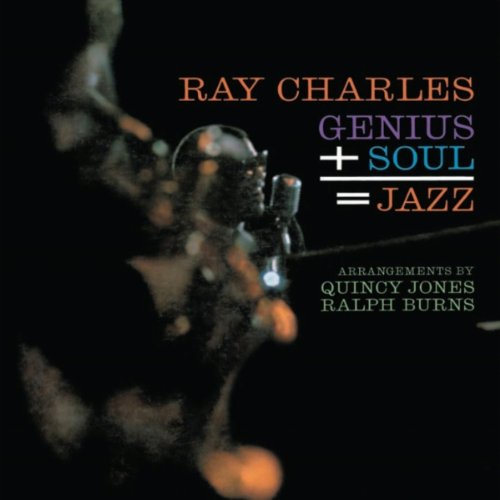
- From The Heart
- I’ve Got News For You
- Moanin’
- Let’s Go
- One Mint Julep
- I’m Gonna Move To The Outskirts Of Town (Clark Terry, on intro - tp, Billy Mitchell - ts)
- Stompin' Room Only
- Mister C (Urbie Green - tb)
- Strike Up The Band
- Birth Of The Blues
Personnel*:
Tunes #1 - 3, 7 - 9:
Ray Charles played the Hammond C3** organ (prepared by Rudy Van Gelder). Seven of the tracks were instrumentals. Other musicians: Philip Guilbeau (all trumpet solos), Thad Jones, Joe Newman, Clark Terry, Eugene (Snooky) Young - trumpets; Henry Coker, Urbie Green, Al Grey, Benny Powell - trombones; Marshall Royal, Frank Wess - alto saxophones; Frank Foster, Billy Mitchell - tenor saxophones; Charlie Fowlkes - bariton saxophone; Freddie Green - guitar; Eddie Jones - bass; Sonny Payne - drums.
 |
| Set of 5 33 1/3 'singles' for jukeboxes (Impulse A2S1 - 5). |
Tunes #4 - 6, 10:
John Frosk, Jimmy Nottingham, Philip Guilbeau (all trumpet solos except intro #6), Clark Terry (trumpet solo on intro of #6), Joe Wilder - trumpet; Jimmy Cleveland, Urbie Green, Keg Johnson, George Matthews - trombone; George Dorsey, Earle Warren - alto saxophone; Budd Johnson, Seldon Powell - tenor saxophone; Haywood Henry - bariton saxophone; Sam Herman - guitar; Joe Benjamin - bass; Roy Haynes - drums.
Creed Taylor on Ray Charles' organ on Genius + Soul = Jazz: "Rudy [Van Gelder] did some adjusting on the inside so the keys had a more percussive effect than a normal one. It was a Hammond B3 doctored by Rudy. He had done this on organs before for other recording dates. The result was a more definite attack than a normal organ."

Quincy Jones (#1, 3, 5, 6, 9), Ralph Burns (#2, 4, 7, 8, 10) - arrangers; Creed Taylor - producer. Quincy hired Clark Terry to "contract the date", i.e. to choose the musicians. Guilbeau was Ray's own choice.
* Based on notes by Joël Dufour. **C3 in stead of B3: read this.
Genius + Soul = Jazz (pron. Genius Plus Soul Equals Jazz) was recorded at the Van Gelder Studios in Englewood Cliffs, on 26 and 27 December 1960. Album: Impulse 2, February 1961.
Phil Ramone later remembered (erroneously?) that he also recorded Ray for this album at A&R Studios in NYC.
The complete album:
For more details, read Ashley Khan's The House That Trane Built: The Story of Impulse Records (New York, 2006).
Subscribe to:
Posts
(
Atom
)


 Posts


