Mediagraphy - Discography - Trackography - Videography - Gigography - Biography - Chronology

27 March 2011

Ray Charles Live In Rome (1999)

On 28 July 1999 Ray Charles, the Ray Charles Orchestra and The Raelettes played a concert at the RomaLive Festival. Read review here; according to this source a.o. the following tunes were on the setlist:
  • Angelina
  • I Can't Stop Loving You 
  • I Want Your Love
  • Smack Dab In The Middle
  • People Will Say We're In Love (with Raelettes)
  • What'd I Say  
The concert was recorded for TV illegally. The day after some band members - much to their surprise - saw back the whole concert in their hotel rooms, on a local channel.* The Italian promoters had possibly allowed the station to tape the gig to make some extra money on the side.

Who knows more?

*Information kindly provided by Brad Rabuchin. 

24 March 2011

Ray Charles Live At Salute To Freedom (1963)

I’ve written a few times about Ray Charles’ position and actions against racism. One of these actions was his contribution to Salute To Freedom, a concert against segregation, held on 5 August 1963 in Birmingham, the capital of U.S. racism in the 1960s. Today I found a contemporary article that I will quote below because it looks as if it may disappear from the web anytime soon.
It’s a fascinating read, mainly depicting the hero’s role – in almost biblical terms - of comedian and AGVA president Joey Adams.
Another alibi to publish it here is because one of the last paragraphs carries proof that a number of news organizations filmed at the event. Some of that footage must have survived. Who knows more?

The article, Neither heat, bombs, nor Birmingham cops shall stop the show - it must go on, was written by Leo Shull, and published in Show Business, Vol. XXIII, no. 32 (10 August 1963), pgs. 1, 10:
Two invasion planes flew into Birmingham, Alabama, Monday August 4 and captured the city. "They captured the right people, too," said Reverend Martin Luther King, "the Negroes and whites who are fighting to attach Birmingham and the whole South to the United States of America." Joey Adams, President of AGVA, had decided to integrate Birmingham for the entertainment industry.
The first plane of show people drafted by Adams had 76 aboard. "The Spirit of 76," said Joey, who had conceived, produced and financed the show and was now the den mother & nursemaid to the apprehensive collection of talent. The second plane departed afterwards and had Ray Charles and his orchestra, crewmen and staff. Mr. Charles and his manager [formally: Ray’s booking agent, BS], Milt Shaw, with Stan Seidenberg [another agent, BS], had chartered and paid for this plane.
In the first aircraft with Joey Adams were his wife, Cindy, and stars, celebrities, newspapermen, Life and Sat Eve[ning] Post and other photographers, disc jockeys and commentators of radio and TV stations, plus several hundred pounds of food and drink, donated to Mr. Adams and his Salute to Freedom riders by Max Asnas, Stage Delicatessen. The planes were paid by donations which Mr. Adams got from Northerners, including $500 from Radio City Music Hall, Maurice Uchital ($2,500); David Dubinsky of ILGWU ($500); Jacob Potofsky of the Hatmakers' Union ($250), Union official Harold Gibbons ($1,000) AGMA ($200) and Int'l Building Trades ($200) plus many smaller contributions.
To dare say, and a Yankee at that, that an integrated show would be smuggled into Birmingham to encourage Negroes and whites to integrate into a black and white audience was like waving a red flag in front of a bull O'Connor—an intolerable insult.
The enemy camp decided to meet it with volleys of silence, from the Mayor of the city, the police, political figures and the Birmingham press which never printed a stick of linotype before or after the event.

Blackout.
The police and Mayor had refused protection, because "this was the first integrated show and audience in the history of Birmingham," declared Rev. A. D. King, brother of Martin Luther, who had organized 500 volunteers to deal with the local problems and preparations, including ticket sales for the show.
Taxi drivers had refused to transport the show's cast and personnel. Rev. King then collected a caravan of 50 private-car volunteers. Hotels had refused lodgings; Adams got a motel, run by A.G. Gaston, former Negro undertaker and now owner of the motel, the local Negro bank and Negro insurance company to provide lodgings. Restaurants refused service. Adams brought along his own food. The city theatre and auditorium owners had refused a meeting hall.
Adams and King got a Negro college campus. There were no chairs. Adams issued a radio call via Negro disc jockey in Birmingham asking people to carry their own - on the night of the show, for three miles people could be seen walking to campus, carrying their own chairs - they had also paid $5 per ticket to see the show.
There was no stage nor lights.
"Build one, buy lights," said Adams. "I'm sending a check for the lumber, lights and electricians. And don't spend a cent of the ticket sales, keep it all to pay for 'The March to Washington Aug. 28,' I'm paying all expenses for this 'Sale to Freedom in Birmingham.'"
Threatening calls and letters, promises of bombings, riots and physical injury all failed to deter the group or the show which went on 9 pm and lasted for five hours. Klu Kluxers and white violence groups began to hold meetings.
Joey Adams had collected for his production Johnny Mathis, Nina Simone, comedian Al Bernie, writers James Baldwin and Harry Golden, Dick Merson, assistant director of News; Billy Taylor and Wm. B. Williams of WNEW; Paul Duke, magician; Billy Rowe, former NYC Deputy Police Coor., now Joe Louis' partner, and Conrad Buckner, dancer, the Gamm Sisters, The Raelettes, Clyde McPhatter, The Shirelles, Dick Gregory, Magid Triplets, the Alabama Christian Movement Choir of 150, the whole orchestra of The Harlem Apollo Theatre led by its conductor, Reuben Phillips. The Alabama musicians union refused to permit Negro and white musicians to play in the same stage.
The cast and crew got off the plane, had lunch at the Gaston motel, then went to a nearby hall and began rehearsals with the orchestras. Sid DeMaye, of AGVA, began co-ordinating the stage routine.
Meanwhile in New York and over press wires the story began to go out. The radio stations from the North began phoning in for progress reports. The newsmen and photographers - about 50 - began work. So did Cleveland Robinson, chairman of the "March on Washington Committee," Clarence Jones of the Ghandi Society.
On the campus, Dr. Lucious H. Pitts, president of Miles College, had mustered volunteer students and alumni to prepare an organization of ushers, service personnel; the carpenters and roof-makers, lighting men and technicians were working in the 98 degree heat - an unusually hot day.
Civilian defense guards had been gathered to take over the protection job that the police refused and had always given to all other public gatherings - and these Negro volunteers came with shot guns to protect the audience from Klu Kluxers who had paraded a few days earlier in protest against the show.
Makeshift floodlights had been set up to light the way for the ticket buyers and to show up any lurking hoodlums or invaders. There were no toilet or rest room facilities, no water, since the field was about a half mile from the college, and five miles from the center of town...
Altho the show was not scheduled till about nine, the audience began to come at noon. Adams had expected 5,000; more than 20,000 people bought tickets, and brought chairs. Many white ticket agencies accepted tickets for sale, a new first.
The Negro people, who had reason to dislike whites, treated the Salute to Freedom members with generous welcome and affection. The response to the show at times was deafening, and great roars greeted many of the acts and the quips of MC Adams, Rev. Martin Luther King, Joe Louis. Adams made a point of publicly embracing many Negro members of the local committees, a sight that would have caused instant arrest a few months ago. The Negroes watched with disbelief and amazement as Negroes and whites chattered, worked and mingled on stage and at the Gaston Motel (which had been bombed a few months ago when they found that Martin Luther King was sleeping on the second floor. A wall of new bricks replaces the old shattered one). Some Negroes asked if they could walk on the street with white members of the show; never seen in Birmingham before.
NBC and other television companies had brought their cameras, as did many of the film newsreel companies.
White and Negroes sitting and eating together became the big photo catch for Negro photographers shooting for Southern Negro newspapers and magazines. More than a dozen Negro disc jockeys journeyed to Miles College and were introduced on the stage. They had been broadcasting this coming event for weeks.
Said James Baldwin to the audience: "This is a living, visible view of the breakdown of a hundred years of slavery - it means that white man and black can work and live together. History is forcing people of Birmingham to stop victimizing each other."
The only member of the United States Government or any of the fifty states to acknowledge there was a new kind of integration drive, was NY's Senator Jacob Javits. He sent a telegram to Joey Adams saying: "Congratulations to all those participating in this significant variety show, my warmest praise goes out to you for this inspiring show which deserves the support of all America interested in freedom and human dignity. Birmingham is an appropriate site for this event. I think this will become the symbol of the breakthru so long awaited and tell the people present I will work to overcome the Senate filibuster to bring civil rights this year."
About four hours after the show began as Johnny Mathis began his song, the stage collapsed and fifty people were hurled down, some of them struck by the falling lumber. The whole field went dark. Electricians restored lights in about a half hour, the audience stayed, the show went on. One man with two broken legs, and the other wounded were taken to hospitals.
The noise of the crash made people think a bomb had gone off, some jumped, John Mathis dove for the floor. (This writer was thrown clear to the grass below.) One of the Magid Triplets was injured, but he did his turn later anyhow. Orchestra instruments were broken, they will be paid for from the $10,000 fund Joey Adams raised.

Upon the return trip, a warning came that a bomb was on one of the planes. It was searched, then all plane riders were halted at the airport gate and questioned, some searched for possible bomb or weapon. The Ray Charles plane flew off. Then the 76 on the second plane embarked. At 5 am it took off. At 9 am it landed at LaGuardia, New York City, U.S.A., Aug. 6, nineteen sixty three.
For a wider perspective on the event and Ray's role, also read this, this, this, this, this, this, and this.

For the later controversy around Ray's concerts in South Africa, read this.

This is how the great Billy Taylor remembered the day:
Also read this article.

Life (Time) has made these photos (not published before) public:

Photos by Grey Villet.

21 March 2011

Genius And Friends (2005)

When a recording artist dies, their record company always gets squeezed between their (and the artist's heirs') commercial interests and their integrity. The questions they usually (have to) ask themselves are: Should we issue these songs, although the artist didn't explicitly approve any release? Should we (re)mix those tunes to our own tastes, since the artist didn't finish them himself? Should we release these finished tapings, although the artist didn't think they were good enough for a release? Should we delve through our vaults, to see if there are any outtakes that are worth a release – although they were never meant for that?
After Ray Charles' death, all kinds of good, some questionable and incidental bad things happened with his musical legacy.

Genius Loves Company was a triumph at Starbucks outlets, on the charts and at the Grammys. And Ray, the soundtrack, was a neat and relevant selection from his best work. What even was better, was that Ray worked on both projects while he was still alive, and - as far as I know - consciously approved, or at least endorsed, the end results.

The relevancy of More Music From Ray, the latter album's sequel, was less clear. It contained some more film tracks that were left off of the first collection (okay), plus some non-movie songs said to inspire the film (odd). But it also had a great surprise for hardcore fans, where it also entailed three new studio takes, film dub tracks for which no other appropriate recordings existed (marvelous), and also sequences where Ray accompanied Jamie Foxx on piano (documentary value).

Pure Genius from 2005 was almost everything a Ray Charles aficionado could dream of when it comes to a compilation: an abundant overview of his work for this label, liner notes with a reasonable quality, a series of lovingly compiled raw studio outtakes from his Atlantic period, and a great video bonus (the Newport 1960 concert) – all in a carefully designed box set.

Ray Sings, Basie Swings (2006) combined archival vocal recordings (taped during a European tour in September 1973) with new performances by a current (2006) Count Basie (Show) Orchestra. Charles was singing his guts out (his voice was probably never better than in the mid 1970s!), but adding the Basie b(r)and to this production was just a marketing trick. The new arrangements lacked balls, and the ensemble lacked the personality of Charles' best orchestra line-ups (a Ray Charles All Stars band and any choice of the historical Raelettes would surely have done a much better job). Combining Charles with Basie in this way, to my taste, came dangerously close to the lack of respect and integrity that more recently infuriated Pat Metheny so much in another case of over the grave-artistry.

Recently, Rare Genius – The Undiscovered Masters  (2010) was another post mortem album release. In itself the release of unknown tracks was good news, of course. But I would have appreciated it if the compilers had made their selection criteria much more clear. Ray was one of the inventors of thematic record albums, but this album was overly theme-less. And as a fan I was disappointed in my expectation that I also would get the opportunity to listen to the pure original, Genius-mastered takes, without the "sweetening" make-over additions – which, to my taste, again were produced with too many outsider studio musicians!

In between all these releases there were all kinds of straight forward, plainly commercial re-releases of other Ray Charles albums and compilations that I won't discuss here. Some of them presented Ray in his original form, some others offered remastered originals. Nothing wrong with that.

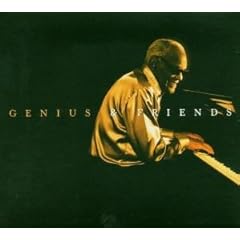
And then there was Genius And Friends, from 2005.
  1. All I Want To Do (with Angie Stone)
  2. You Are My Sunshine (with Chris Isaak)
  3. It All Goes By So Fast (with Mary J Blight)
  4. You Were There (with Gladys Knight)
  5. Imagine (with Ruben Studdard & The Harlem Gospel Singers)
  6. Compared To What (with Leela James)
  7. Big Bad Love (with Diana Ross)
  8. I Will Be There (with Idina Menzel)
  9. Blame It On The Sun (with George Michael)
  10. Touch (with John Legend)
  11. Shout (with Patti LaBelle & The Andrae Crouch Singers)
  12. Surrender To Love (with Laura Pausini)
  13. Busted (Live Version) (with Willie Nelson)
  14. America The Beautiful (with Alicia Keys)
According to Rhino/WEA’s press kit, they took a series of studio tracks that Ray had been working on in 1997 and 1998 as a basis for this album, and fused them with vocals by contemporary artists to create another duet album. The album was presented as the end result of a project that Charles initiated a few months before his death. Ray had called James Austin in December of 2003, asking if he could find the masters of an unreleased duets record. Still according to the same Rhino publicity rap, Charles was too sick to work on them, so after his passing the company decided to finish off the project, bringing in producer Phil Ramone to oversee the completion of the album. This also included bringing in singers to record their parts, since apart from the 1991 duet with Diana Ross on Big Bad Love and the live 1991 version of Busted with Willie Nelson (taken from the television special Ray Charles: 50 Years In Music, Uh-Huh!), these were all studio artefacts, with vocalists duetting with a previously recorded Ray. Ramone edited the new recordings with the existing tapes.
It rarely sounded as if the vocalists were in the same room together. To real fans, a critic wrote, the album was just a painful reminder that The Genius had left the building.

But there’s more to this story.

In an interview by Sandra Cesarale in the Corriera della Sera of 27 July 1999 Ray stated that he was working on a record project to be released in September of that year, produced by “my friend Quincy Jones”, where Charles would sing with “the young Brandy”, George Michael, Stevie Wonder, and Gladys Knight. "But in [this] project I also want to involve the queen of disco music: Gloria Gaynor.”

When Genius And Friends was first announced on Amazon (on 25 May 2005) the published track list was:
  1. You Are My Sunshine
  2. Imagine
  3. It All Goes By So Fast - Mary J. Blige
  4. I Believe In Your Touch - John Legend
  5. Big Bad Love - Diana Ross
  6. Busted – Wille Nelson
  7. Living For the City
  8. All I Want to Do - Angie Stone
  9. Compared to What
  10. Shout - Patti LaBelle with The Andrae Crouch Choir
  11. You Were There - Gladys Knight
  12. Blame It On the Sun - George Michael
  13. You Leave Me Breathless
  14. America the Beautiful – Alicia Keys
Track #7 clearly refers to the missing duet with Stevie Wonder, probably more specifically to a release of their magnificent performance of Living For The City during the Ray Charles: 50 Years In Music, Uh-Huh! show in 1991. It's a riddle with whom the duet on You Leave Me Breathless was (planned to be) recorded. Gaynor? Brandy? One of the other artists mentioned in the Fox News article quoted below?

The disappearance of Brandy and Stevie (and possibly also of some other artists) from the track list may have had all kinds of good or less good (business) reasons (e.g. the refusal of their own record companies to clear their collaboration on this album), while Patti LaBelle’s contribution may just have been an incidental matter of bad judgment by the producers (it's very hard to conceive that Ray would have ever even allowed her access to RPM Studios). But on 29 August 2005 Fox News published a story by Roger Friedman, titled 'Genius II' Loves Trouble, that suggested more serious problems. The narrative is clearly based on gossip, and I have seen better fact checking, but the writer's sources must have been people close to Ray and RPM who were truly concerned about the integrity of the whole project:
"Don't get too excited about those announcements last week of a "new" Ray Charles duets album. I'm told there's trouble brewing on this project that has not been addressed.
Earlier this year, Charles won a posthumous Grammy award for his Genius Loves Company album on Concord Records.
That was a collection of digitized duets, but the combination of Charles' untimely death and the movie Ray [...]drove the CD to sales of 3 million in the United States. It caused a Ray Charles renaissance of the first order.
So, what to do? Some at the Charles estate [this most probably refers to Joe Adams, BS] wanted a Genius II but the tracks didn't exist. Then someone remembered that Charles had recorded a bunch of duets years ago and hadn't released them.
The original tracks were recorded for Quincy Jones' now-defunct Qwest Records […].
Estate insiders thought: Wouldn't it be a great idea to release these duets? Maybe. But apparently they also felt the original collaborators were no longer relevant or commercial enough to market.
Charles' collaborators on those tracks included Brandy, Brownstone, Chuckii Booker, B.B. King, En Vogue, Faith Evans and Stevie Wonder. In fact, there's supposedly a duet between Wonder and Charles on Living For The City that's supposed to be spectacular.
Critics of the Charles estate, however, tell me there's such a clamor to make more money from the deceased legend that insiders have gone too far this time. Apparently, all those artists who actually recorded with Charles in the studio have been "erased" and their vocals replaced by Patti LaBelle, Diana Ross [wrong info; the duet Big Bad Love was taped and released by Ross in 1991, BS], and other artists considered bigger stars now.
It is not known whether the original singers have been notified that their vocals have been eliminated.
Two of the new vocalists are Alicia Keys and Ruben Studdard, neither of whom Charles even knew [at least partly wrong, Ray consciously contributed to Keys’ - awful, awful - rendition of America The Beautiful, especially produced for the 2003 Super Bowl halftime show, BS], critics charge. Additionally, there's the matter of LaBelle, who - though revered by many - was not particularly liked by Charles.
Wonder, I am told, declined to sign off on releasing his duet for this new weird collection.
All of this may come as a shock to Atlantic Records chief emeritus Ahmet Ertegun, whose name was used in the press release announcing the album on Rhino Records. You can still find Internet references to an album called Duets, which Rhino declined to release in 1998.
The release claimed that Ertegun was fulfilling a "deathbed" promise to Charles to put out his material. But since Charles had not recorded for Ertegun since leaving Atlantic in 1959, that claim may be dubious at best [wrong for several reasons, but mainly because Atlantic actually was involved in releasing the album through Warner-Elektra-Atlantic, or WEA for short, BS].
It's nothing new that dead artists are exploited. Charles seems destined to join Jimi Hendrix, Janis Joplin and countless others now that he's gone to his great reward. I'm told he left behind hundreds of unreleased recordings that should provide lots of legal tangles."
Also read this article for the point of view of Ray's children.

However, let us pray that the remainder of Ray's musical legacy will be treated with much more respect. And integrity. There's still a lot of work to be done!

Album: Rhino/WEA, 20 September 2005, ASIN: B000AMPYZY.


27 February 2011

Ray Charles Live in Antibes (1961 - 2001)

Ray's concerts at Antibes span his whole international live career. After his debut at the edition of 1961 it took him 15 years to return, but after 1976 he came back every 2 or 3 years: in 1978, 1979, 1982, 1983, 1985, 1987, 1990, 1992, 1997, 1999, and 2001. All of his visits to Antibes are documented on film, video, or audio.

Jazz has been part of Antibes' musical landscape since the mid 1920’s. The music was introduced to Antibes by the American artist and jazz music connoisseur Gerald Murphy and his visiting guests, such as F. Scott Fitzgerald.
During its second season, Juan’s new casino welcomed a troupe of Charleston dancers one evening. Captivated by the atmosphere of this crazy night, the Murphy’s organised a sumptuous private party which was to inspire Scott Fitzgerald’s most famous novel, Tender Is the Night, and the Murphy’s lifestyle in Antibes would serve as a model for his other masterpiece, Les Enfants du Jazz.
In 1928, Gerald left Antibes for Hollywood where the film maker King Vidor asked him to be his advisor for the shooting of Hallelujah, the first film played entirely by black actors and dedicated to their culture.
Jazz in Juan, at this period, remained carefree. As early as 1927, the Auberge du Pin Doré welcomed the Blue Lagoon Orchestra, and the following year, the inauguration of the Pré-Catelan took place to the sounds of Danny’s Jazz Band. In 1932, Juan celebrated the 250th anniversary of champagne and for this tribute to Dom Pérignon, the new club Maxim’s accommodated no less than three orchestras: jazz, tango and rumba.
Sidney Bechet married in Antibes in 1951 and organized one of the biggest street parties ever seen on the French Riviera. At the event that Picasso painted his famous La joie de vivre masterpiece. After Bechet’s death in 1959, the first Jazz à Juan was held to pay tribute to his talent and passion for jazz (the event was organized by Jacques Hébey and  Jacques Souplet). Since then, at the heart of the Pinède Gould, the longest-running European jazz festival, Jazz à Juan, takes place each summer.
The 1960 edition was the origin of a number of other festivals that spread throughout Europe (Claude Nobs, creator of the major European jazz event that we know as Montreux, said "If I hadn’t stopped by at Antibes, Montreux would not have existed"). It attracted many of the great names of the time, including Charles Mingus, Duke Ellington, Dizzy Gillespie and Ella Fitzgerald.
The following year, 1961, Ray Charles came for the first time. He came back (the story goes, but I fail to see the direct connection, BS;-) so many times that Juan les Pins was twinned with the "French Quarter" in New Orleans.

Ray Charles in France
Ray was immensely popular in France. Jazz Hot magazine started featuring him in 1959, followed him for 10 days in 1961, put him on the cover in 1961 and in 1962, and kept on featuring him closely until the end. 

20 February 2011

Rita Graham, Vibrations (Ray Charles On Piano) (1969)


  1. You Better Go Now
  2. Quiet Nights Of Quiet Stars
  3. (There Is) No Greater Love
  4. Meditation
  5. P.S. I Love You
  6. Charade
  7. The Genie
  8. My Cup Runneth Over
  9. You'd Be So Nice To Come Home To
  10. Cover photo by Howard Morehead. 
  11. If I Could Be With You (One Hour Tonight)
    Recorded at RPM International in Los Angeles, in three sessions at RPM Studio in Los Angeles.

    On February 23, 1968 #1, #2, #8, and #9 were recorded with Clifford Scott (flute); Billy Preston, ; Barry Rillera (guitar); Al McKibbon (electric bass); Edward “Sharky” Hall (drums); Jerry Reisler, Stanley Plummer, William Kurasch, William Weiss, Mischa Russell, Bill Hymanson, Tibor Zelig (violin); Joe DiFiore, Harry Hyams (viola); Ray Kelley (cello).

    On March 25, 1968 #3, #4, #5 and Treat Me Good were recorded with Jim Horn (electric flute); Truman Thomas (piano); Howard M. Roberts (guitar); Bob West (electric bass); Earl Palmer (drums); Sid Sharp, Marshall Sosson, Lou Klass, Israel Baker, Tibor Zelig, Ralph Schaeffer, William Kurasch (violin); Harry Hyams, Joe DiFiore (viola); Jesse Ehrlich (cello).

    The details of the third session, where #6 and #7 were recorded, are unknown.

    Treat Me Good can probably be identified with the Jimmy Radcliffe / Buddy Scott song, as recorded e.g. in 1967 by Julie London for her With Body And Soul album (Liberty ‎LRP-3514).

    Sid Feller (arranger, conductor, producer); Ray Charles (co-producer).

    From the liner notes by Lu Washington: "Rita Graham combined her innate musical talents with the painstaking aid of Ray Charles to produce this unusual work. From the time of her discovery by Ray Charles, he has worked relentlessly with Miss Graham in developing her style."

    All in all, it took one and a half year to produce the album. Read this interview with Rita: on their first meeting, the recording of the album, the lack of promotion, and her later role as a Raelette. Her webpage is here.

    Tangerine TRCS 1507, 1969.


    Bought Blues (By Percy Mayfield, Ray Charles On Piano) (1971)

     
    1. Never No More*
    2. Ha Ha In The Day Time*
    3. I Reached For A Tear*
    4. My Bottle Is My Companion
    5. We Both Must Cry
    6. River's Invitation*
    7. Pretty Eyed Baby
    8. Long As You're Mine
    9. You Don't Exist Anymore
    10. Fading Love
    * Ray played on these tracks. Known personnel on Percy's earliest Tangerine tracks: Percy Mayfield - vocals; Ray Charles - piano; Marcus Belgrave - trumpet; Hank Crawford - alto saxophone; Sonny Forriest - guitar; David Fathead Newman - tenor saxophone; Edgar Willis - bass; Milt Turner - drums; Billy Preston - organ; Gerald Wilson - arranger.

    (The liner notes to the 2003 compilation CD also mention Al McKibbon - bass, Teddy Edwards - tenor saxophone, Howard Roberts - Guitar, Johnny Guitar Watson - guitar, Chuck Norris - guitar).
    Album: Tangerine TRCS 1510, 1971. Compilation album: Percy Mayfield, His Tangerine And Atlantic Sides. Rhino Handmade, 2003, ASIN: B0001MMG36:

    For the documentary read this.

    My Jug And I (By Percy Mayfield, Ray Charles On Piano) (1966)


    1. My Jug And I
    2. River's Invitation
    3. Baby Please
    4. Stranger In My Own Home Town
    5. Never Say Naw
    6. The Hunt Is On
    7. Memory Pain
    8. I Reached For A Tear
    9. Life Is Suicide
    10. Maybe It's Because Of Love
    11. Give Me Time
    12. Fading Love

    Recorded between 1963 and c. 1966 at unidentified studios, prob. in Los Angeles.

    Personnel on Percy's Tangerine tracks 1962 - 1971: Percy Mayfield - vocals; Ray Charles - piano; [needs revisionsBilly Preston - organ; Hank Crawford - alto saxophone; David Fathead Newman - tenor saxophone; Marcus Belgrave - trumpet; Sonny Forriest - guitar; Edgar Willis - bass; Milt Turner - drums]. Gerald Wilson - arranger.

    Album: Tangerine TRCS 1505, 1966.
    The tracks of the elpee were also released on the compilation album Percy Mayfield, His Tangerine And Atlantic Sides. Rhino Handmade, 2003.


    17 February 2011

    Genius & Soul: The 50th Anniversary Collection (1949 - 1993)


    This 5-CD compilation boxset includes 16 tracks from singles that were not before coherently reissued on an album, some duets otherwise only known from other artists' albums, and two hidden bonus tracks with soundtracks of commercials.


    5-CD Box, Rhino/WEA, 16 September 1997, ASIN: B00000343O.


    Disc 1
    1. Confession Blues
    2. Baby Let Me Hold Your Hand
    3. Kissa Me Baby
    4. It Should've Been Me
    5. Don't You Know
    6. Come Back Baby
    7. I Got A Woman
    8. A Fool for You
    9. This Little Girl Of Mine
    10. Blackjack
    11. Greenbacks
    12. Drown In My Own Tears
    13. Hallelujah, I Love Her So
    14. Lonely Avenue
    15. Leave My Woman Alone
    16. Ain't That Love
    17. Swanee River Rock (Talkin' 'Bout That River)
    18. My Bonnie
    19. Rock House, Pts. 1-2
    20. Night Time Is The Right Time
    21. What'd I Say, Pts. 1 & 2
    22. Tell The Truth
    23. I Believe To My Soul
    24. Don't Let The Sun Catch You Crying
    Disc 2
    1. Let The Good Times Roll
    2. Come Rain Or Come Shine
    3. Tell The Truth
    4. Drown In My Own Tears
    5. I'm Movin' On
    6. My Baby (I Love Her, Yes I Do)
    7. Sticks and Stones
    8. I Wonder
    9. Georgia on My Mind
    10. Them That Got
    11. Ruby
    12. Hard Hearted Hannah
    13. I've Got News for You
    14. One Mint Julep
    15. I'm Gonna Move To The Outskirts Of Town
    16. Hit The Road Jack
    17. Danger Zone
    18. Unchain My Heart
    19. But on The OTher Hand Baby
    20. Baby, It's Cold Outside
    21. Ev'ry Time We Say Goodbye
    22. At The Club
    Disc 3
    1. Hide Nor Hair
    2. I Can't Stop Loving You
    3. Bye Bye Love
    4. Born To Lose
    5. You Don't Know Me
    6. You Are My Sunshine
    7. Your Cheatin' Heart
    8. Take These Chains From My Heart
    9. The Brightest Smile In Town
    10. Without Love (There Is Nothing)
    11. Busted
    12. That Lucky Old Sun (Just Rolls Around Heaven All Day)
    13. Ol' Man River
    14. Smack Dab In The Middle
    15. Makin' Whoopee
    16. Without A Song, Pts. 1 & 2
    17. The Cincinnati Kid
    18. Crying Time
    19. Let's Go Get Stoned
    20. I Chose To Sing The Blues
    21. Together Again
    22. I Don't Need No Doctor 
    Disc 4
    1. Eleanor Rigby
    2. Yesterday
    3. Understanding
    4. Driftin' Blues
    5. Here We Go Again
    6. In The Heat Of The Night
    7. Gee Baby, Ain't I Good To You
    8. I Didn't Know What Time It Was
    9. If It Wasn't For Bad Luck
    10. We Can Make It
    11. Don't Change on Me
    12. Feel So Bad
    13. Look What They've Done To MySong, Ma
    14. Spirit In The Dark (Reprise)
    15. Booty-Butt
    16. I Can Make It Thru The Day (But Oh Those Lonely Nights)
    17. Rainy Night In Georgia
    18. America The Beautiful
    (Hidden Track: Coca Cola Commercial)

    Disc 5
    1. Living For The City
    2. Till There Was You
    3. Am I Blue
    4. How Long Has This Been Going On?
    5. The Jealous Kind
    6. Is There Anyone Out There?
    7. Don't You Love Me Anymore
    8. One Of These Days
    9. Seven Spanish Angels
    10. We Didn't See A Thing
    11. Two Old Cats Like Us
    12. Shake A Tail FeaTher
    13. I'll Be Good To You
    14. That's Where It's At
    15. A Song for You
    16. Still Crazy After All These Years
    (Hidden Track: Olympia Beer Commercial) 

    07 February 2011

    Ray Charles Featured In Down Beat (1956)

    This is the first full page magazine article about Ray Charles that I know of, from Down Beat, dated 28 November 1956. Wexler's quote on the "soul part" of the blues is remarkable - possibly the earliest instance where Ray's music was associated with the term soul. The essence of RC's biographical mantra is there, but small mistakes ("parents", "uncle") show that Ray can't have been personally involved in briefing the writer.

    06 February 2011

    Rare Photos Of The Ray Charles Orchestra & The Raelettes In Paris (1963)

    Early photos of Ray Charles are relatively rare, but photos from the musicians in his band and of The Raelettes are really scarce. People who regularly follow this blog have seen that lately I've spent quite some effort in documenting the few pics that are available on the web.

    That's how I came across the Facebook page of trumpet player Phillip (Phil) Guilbeau (1926 - 2005), maintained by his daughter Nina. Browsing that page about a week ago, I found a magnificent photo of the Ray Charles Orchestra, obviously from the early 1960s. Intrigued and touched by a comment of one of Guilbeau's grandchildren ("who are all these people"?), I shared the same photo on my own Facebook page, and asked people to help me tag the protagonists in the photo. Things went fast when Leroy Cooper biographer Susan Cross asked Joel Dufour, the #1 Ray Charles connaisseur in the world, to help me out. Joel responded immediately, with a full concordance of the musicians in the photo...
    ...and with one even bigger surprise. He saw that the photo was from the same series that was published on 23 May 1963 in France Soir, and added a cut out from a variant photo in that publication, where the Raelettes and singer Jean King have stepped into the frame of the Orchestra picture. The pictures were taken in Paris, Dufour writes, presumably on 22 May 1963.
    Musicians: 1. Julian Priester (tb), 2. James Harbert (tb), 3. Phillip Guilbeau (tp), 4. Wallace Davenport (tp, band leader), 5. John Hunt (tp, flh), 6. Oliver Beener (tp), 7. Henderson Chambers (tb), 8. Frederic 'Keg' Johnson (b, tb), 9. Edgar Willis (b), 10. Wilbert Hogan (dm), 11. Elbert 'Sonny' Forriest (g), 12. Bennie 'Hank' Crawford (as), 13. James Clay (ts), 14. William 'Buddy' Pearson (as), 15. Leroy Cooper (bs). Singers: 16. Marjorie (Margie) Hendricks (Raelette), 17. Gwen(dolyn) Berry (Raelette), 18. Jean King (featured singer), 19. Priscilla (Pat) Lyles (Raelette), 20. Ethel (Darlene) McCrea (Raelette).

    That week Ray sold out his show at the Olympia Theater for seven (May 22nd - 28th) days in a row. Jean (Louise) King (1938 - 1983), of Blossoms fame, had her own solo spot in these concerts, accompanied by Ray and the band.
    David Fathead Newman was missing in the Orchestra line-up. He had been arrested for drug possession a few days before by the British police. Later that week he joined the group again in Paris (and again caused some - this time internal - drugs-related trouble), but he didn't make it to the concerts because his place in the band was already taken by the English tenor saxophone player Vic Ash, the first white cat ever to play in Ray's band (don't miss his autobiography, I Blew It My Way).
    Phil Guilbeau, on trumpet of course, had to fill in the flute parts on Georgia On My Mind (a partial sound recording has survived).

    Some TV footage of the 1963 French tour has survived; see this.
     Band leader and trumpet player Wallace Davenport, Ray Charles, and Vic Ash.