Mediagraphy - Discography - Trackography - Videography - Gigography - Biography - Chronology

Showing posts with label Canon. Show all posts

27 January 2011

Brother Ray Is At It Again (1980)

  1. Compared To What
  2. Anyway You Want To
  3. Don’t You Love Me Anymore (flugelhorn solo by Bobby Bryant Freddie Hubbard*)
  4. A Poor Man's Song
  5. Now That We've Found Each other
  6. Ophelia
  7. I Can't Change It
  8. Questions
Crossover/Atlantic SH 8546, March 1980.

This album was released more than a year after the first edition of Brother Ray; Ray Charles' Own Story, the autobiography co-written with David Ritz, a moderate bestseller in 1978, and a little before the release of The Blues Brothers. Nevertheless, this release was hardly noticed, and now the album is almost totally forgotten.

The musicians were not credited. Bobby Bryant (trumpet) and David T. Walker (guitar) were amongst the session musicians. The backing vocals on #1 were possibly sung by The Raelettes; the choir on #7 remains unidentified. Arrangers: Mike Post (#1, 4, 6), Larry Muhoberac (#2, 5), Nan Schwartz (#3), Ray Charles (#7 and #8 together with), Sid Feller.

* This new attribution is based on a consensus among trumpetist alumni of the Ray Charles band.


Full album:


    13 September 2010

    Love And Peace (1978)


    1. You 20th-Century Fox (James Gadson on drums)
    2. Take Off That Dress
    3. She Knows
    4. Riding Thumb
    5. We Had It All
    6. No Achievement Showing
    7. A Peace That We Never Before Could Enjoy
    8. Is There Anyone Out There
    9. Give The Poor Man A Break
    Love And Peace was the first Ray Charles album produced on 24 tracks, at RPM. Ray used them all.

    The musicians remained uncredited. As usual in these years, Ray worked with The Raelettes, members of his Orchestra and session musicians.
    Peter Turre, Ray's drummer for many years, informed me that Steve Beskrone (bass) played on a lot of the tracks, with studio ace Paul Humphries and funkmaster supreme James Gadson on drums. Drummer Scott von Ravensberg recalls re-recording the drum tracks on #2, 4, 7 and 9. I guess that means that Paul Humphries can still be heard on on She Knows, We Had It All, No Achievement Showing and Is There Anyone Out There.

    Crossover/Atlantic 19199, 1978-09.

    Complete album (audio only):

    10 September 2010

    Rare Genius – The Undiscovered Masters (2010)

    Rare Genius was yet another post mortem album, released on 26 October 2010. The album was announced as a "treasure trove of newly discovered recordings", "culled from four decades worth of demos and other previously unreleased material", from the '70s, '80s and '90s. According to the press release, "Adding a little sweetening to some of the sparse, stripped-down tracks was a team of top-notch musicians and artists: guitarists Keb' Mo' and George Doering, organist Bobby Sparks, trumpeter Gary Grant, trombonist Alan Kaplan, bassists Trey Henry and Chuck Berghofer, drummers Gregg Field and Ray Brinker and background vocalist Eric Benet." 

    This album is good news, of course. I wonder about the selection criteria. Ray was one of the inventors of thematic albums...; do we have a theme here? Why these tracks, and what more can we expect to come from the RPM Vaults in the foreseeable future? "The Undiscovered Masters" is an odd contradictio in terminis, and I really hope that "The" doesn't mean that the discovery adventures of Concord and the Ray Charles Foundation are over now. I certainly hope that we, ever, also get the opportunity to listen to the pure original, Genius-mastered takes, without the "sweetening" make-over additions. 
    1. Love's Gonna Bite You Back
    2. It Hurts To Be In Love
    3. Wheel Of Fortune
    4. I’m Gonna Keep On Singin'
    5. There'll Be Some Changes Made
    6. Isn't It Wonderful
    7. I Don’t Want No One But You
    8. A Little Bitty Tear
    9. She’s Gone
    10. Why Me, Lord (with Johnny Cash) 
    Album: Concord Records, 25 October 2010, ASIN: B003ZDZ1Y4.

    #1 - Love’s Gonna Bite You Back (recorded in March 1980):


    #2 - We know  It Hurts To Be In Love from a number of recorded concerts. See this. Free download here.


    #3 - Hear Kay Starr's version of Wheel Of Fortune here; soundclip of Ray's version:


    #4 - Since the 1970s Ray used this tune frequently as an intro (in 10- to 60-second versions) to What'd I Say, but to my knowledge never performed a complete version. See this.


    #5 - Ray played There’ll Be Some Changes Made once at the Tonight Show and once at the Ear International 2nd Annual Ray Charles Birthday Celebration. Also see this.


    #7 - I Don't Want No One But You (soundclip): 


    #8 - A Little Bitty Tear (Hear Burl Ives' version here); soundclip:


    #9 - She's Gone (soundclip):  


    #10 - Why Me, Lord was discovered in the Sony vaults; the Kristofferson song was produced by Billy Sherrill in Nashville in 1981 for a Johnny Cash CBS album - which never was released. Hear this Johnny Cash version, or Kris Kristofferson's live version here. More here.


    Promo: 


    Track-by-track walk-through with john Burk, producer:


    The Making of Rare Genius (1): 


    The Making of Rare Genius (2):  


    Rare Genius - Goin' Country: 


    Ray Charles and Johnny Cash:  

    22 April 2010

    Live At The Newport Jazz Festival (1960)

    1. The Story (solos by Phil Guilbeau - tp, Leroy Cooper -  bs, John Hunt - flh, Hank Crawford - as, David Newman - ts, Ray Charles - p)
    2. Lil' Darlin' (solos by Ray Charles - p, John Hunt - flh, Phil Guilbeau - tp, David Newman - ts, Hank Crawford - as)
    3. Blues Waltz (solos by Phil Guilbeau - tp, Hank Crawford - as, John Hunt - flh, David Newman - ts, Leroy Cooper - bs, Ray Charles - p)
    4. Let The Good Times Roll (solo by David Newman - ts)
    5. Don't Let The Sun Catch You Crying (solo by John Hunt - flh)
    6. Sticks And Stones 
    7. My Baby (I Love Her, Yes I Do) (ft. Margie Hendricks)
    8. Drown In My Own Tears
    9. What'd I Say
    10. I Believe To My Soul
    The concert took place on 2 July 1960. The film was first released as part of the Boxset Pure Genius: The Complete Atlantic Recordings (1952-1959)
    Atlantic/WEA, 20 September 2005. The bonus item on this DVD is an interview with Ahmet Ertegun by Taylor Hackford.

    The Story (#1) erroneously is called Joy Ride in most sources.

    The film on the DVD is presented by Willis Conover - as part of the series Jazz USA. The filmed concert is also known as Newport Jazz Festival 1960. The footage has been shelved by Historic Films.
    The concert or a part of it was possibly aired by CBS in the World Jazz Series, hosted by Mitch Miller (broadcast on 4 consecutive nights, from July 1 to 4). Voice Of America aired the whole concert as a "public service presentation by the United States Information Service".

    The audio of the concert, at least partially, is archived in the Voice of America collection at the Library of Congress.
    One tape (RGA 0070; RWD 5745 A2-B1) specifies the following titles (I'm quoting the erroneous orthography of the LoC catalog):
    1. The blues [= Blues Waltz]
    2. Let the good times roll
    3. Don't let the sun catch you cryin'
    4. I've been accused [= Sticks And Stones]
    5. My baby
    6. Drowning [= Drown] in my own tears
    7. What'd I say
    8. I believe [to my soul]
    The other tape (RGA 0069 (RWD 5744 B3) just has:

         9.  Li'l Darlin'

    Joy Ride is an incorrect identification - this tune is The Story; it obviously didn't get aired; Lil' Darlin' may have been broadcast later, separately.
    Ray Charles, backstage with
    Columbia Records' Mitch Miller.
    Photo by Allan Morrison.
    This source also mentions a documentary Newport '60 in four 25-minute parts, with Muddy Waters, Otis Spann, John Lee Hooker, Ray Charles, Sammy Price, Jimmy Rushing. Wolfgang's Vault shares other parts of the festival's blues program, and has an interesting article and dramatic sound squibs on the riots that took place, and the closing of the festival.
    Program pages in the festival's
    souvenir brochure.
    In a later interview, Annie Ross (see photo) remembered, "Finally we did the Newport Jazz Festival. That was the year of the riots. I think it was Oscar Peterson who couldn't get through the people who were protesting. I forget what they were protesting about. Don't even know. But they said to us, "Don't just do 15 minutes. You can do half an hour," which for us was incredible, because we were always being told, "You have 15 minutes" or 10 minutes, and we were just starting to stretch when we got to that point. So they told us to do a half an hour, which we did. That's where I got a chance to dress with the Raelettes. Ray Charles was on. He was phenomenal. But dressing with the Raelettes was a trip. It was wonderful. They loved our music, and we loved them. We went on and on."
    Backstage, chatting with with Lambert, Hendricks and
    Ross (from
    Ebony, Sep. 1960). Photo by Allan Morrison.

    Personnel:
    Musicians: Phil Guilbeau - trumpet, John Hunt - flugelhorn; Hank Crawford - alto saxophone; David Fathead Newman - tenor saxophone; Leroy Cooper - baritone saxophone; Edgar Willis - bass; Milton Turner - drums. The Raelettes: Gwen Berry, Margie Hendricks, Mae Mosely, Bettye Smith.

    Wolfgang's Vault has brought the (whole?) audio part of the concert to the Web. It's not completely congruent with the description of the Voice of America tapes kept at the Library of Congress. Also read this.
    Wolfgang's has released a (regrettably incomplete) version of the concert on vinyl: Ray Charles - Newport 1960 (Concert Vault Vinyl Series, 2014, NJF3600702-VL).

    All tunes, except for The Story:
    Joël Dufour has helped me to get many data in this article right.

    27 February 2010

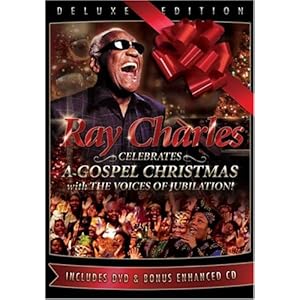
    Ray Charles Celebrates A Gospel Christmas (2002)

    Original caption to this Reuters photo: "Singer Ray 
    Charles poses at the piano at his Los Angeles 
    recording studio August 21, 2002 to promote his 
    upcoming Gospel music concert titled The Gospel
    According to Ray Charles featuring the Voices of
    Jubilation. Charles returns to his roots with this 
    first ever Gospel music concert set for September 5 
    and 6 at the Kodak Theatre in Hollywood 
    accompanied by the 70 member Voices of Jubilation 
    choir from Newark, New Jersey."
    An audio version of this show located the concert at the Resch Center in Green Bay (WI), and dated the taping on 8 December 2002. The original plans were different (see caption, right). For this concert Ray Charles was joined by the 70-member* Voices of Jubilation Gospel Choir of Newark.

    Ray's voice was frail those years, but in most tunes he wins the listener over by the force of his interpretations - and with some cool keyboard playing.

    The footage has been re-released a few times, also abridged, and/or under different titles. The Deluxe Edition CD/DVD released in the winter of 2004 climbed to #2 on the Billboard Gospel Charts. Ray Charles, Jr. was a co-producer, Stuart Benjamin directed and was executive producer with Mike Parris and Jennifer Smith.

    VHS: Urban Works, 7 October 2003, ASIN: B0000A2ZT8.

    DVD: Urban Works, 23 November 2004, ASIN: B0002VEQKM.

    Audio CD: EMI Records, 27 November 2006.

    Read press release here. Also read this.


    Ray appeared twice on stage, and performed:
    1. What Kind Of Man Is This
    2. The Christmas Song (Chestnuts Roasting On An Open Fire)
    3. All Night, All Day
    4. Have Yourself A Merry Little Christmas (with Harold Dudley)
    5. Oh, Happy Day
    6. Rudolph The Red-Nosed Reindeer
    7. Hark! The Herald Angels Sing (Stefanie Minatee; RC - kb)
    8. Silent Night
    9. Little Drummer Boy
    10. America The Beautiful
    * Other sources say 100 or 120. 

    Full DVD:


    The following 1h4m version of the concert presents the materials as if Ray was guesting, but further below, I'm embedding audio files of the tunes (check YouTube for more video footage!):


    26 February 2010

    Ray Sings, Basie Swings (1977/2006)

    1. Oh, What A Beautiful Morning
    2. Let The Good Times Roll
    3. How Long Has This Been Going On
    4. Every Saturday Night  
    5. Busted   
    6. Crying Time  
    7. I Can't Stop Loving You  
    8. Come Live With Me 
    9. Feel So Bad
    10. The Long And Winding Road 
    11. Look What They've Done To My Song
    12. Georgia On My Mind 
    From Billboard, 11 August 1973.
    In that year Ray of course played 
    with his own Orchestra.
    Ray Sings, Basie Swings combined archival Ray Charles vocal recordings (according to Concord taped in 1973 with the Count Basie Orchestra*) with new performances by a current (2006) Count Basie (show) Orchestra. Ray Sings, Basie Swings was created with the the latest recording and mixing technology. See Wikipedia for personnel listing.
    Charles is singing his guts out (his voice was probably never better than in the mid 1970s), but he never played with the Basie orchestra, so adding the Basie b(r)and to this production was just a marketing trick. The new arrangements lack balls, and the ensemble lacks the personality of Charles' best orchestra line-ups (a Ray Charles All Stars band and any choice of the historical Raelettes would surely have done a much better job).
    CD: Concord Records, 3 October 2006, ASIN: B000H0MNOE.

    * This dating in 1973 and the claim that Ray was recorded playing with the Count Basie Orchestra are problematic, and probably incorrect, since a) Oh, What A Beautiful Morning and How Long Has This Been Going On were first released in 1977, b) no live programs with a co-billing of Ray Charles and Count Basie are known after 1973 (nor is there even a sliver of evidence that they ever played together).

    Trailer:

    25 February 2010

    Ray Charles - Berlin 1962

    1. Band Intro
    2. Strike Up The Band (With The Ray Charles Orchestra) 
    3. One Mint Julep (With The Ray Charles Orchestra)  
    4. I've Got A Woman 
    5. Georgia On My Mind
    6. Margie
    7. The Danger Zone
    8. Hallelujah I Love Her So
    9. Come Rain Or Come Shine
    10. Hide Nor Hair
    11. Alexander's Ragtime Band
    12. I Believe To My Soul
    13. Hit The Road, Jack
    14. The Right Time (Night Time Is --) (ft Margie Hendricx)
    15. Bye, Bye Love
    16. Unchain My Heart
    17. What'd I Say
    This concert of Brother Ray with big band and The Raelettes was recorded at the Sportpalast in Berlin on 6 March 1962, and was released in April 1996 by jazz impresario Norman Granz on the Pablo label, in the series Norman Granz' Jazz At The Philharmonic.

    Personnel:
    Musicians: Ray Charles - vocals, piano, organ; Marcus Belgrave, Wallace Davenport, Phil Guilbeau, John Hunt – trumpets; Henderson Chambers, James Harbert, Keg Johnson, Dickie Wells – trombones; Hank Crawford, Rudy Powell – alto saxophones; David Newman – tenor saxophone, alto saxophone, flute; Don Wilkerson – tenor saxophone; Leroy Cooper – baritone saxophone; Sonny Forriest – guitar; Edgar Willis – bass; Bruno Carr – drums. The Raelettes: Gwen Berry, Margie Hendricks, Pat Lyles, Darlene McCrea.
    Norman Granz – producer.

    Pablo 5301, 1996-04.

    Strike Up The Band:


    One Mint Julep (from Out Of The norm, The Life And Times Of Norman Granz, a BBC Radio 2 program from 12 December 2003):


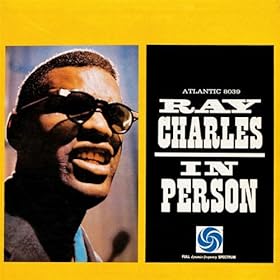
    Ray Charles In Person


    1. (Night Time Is) The Right Time
    2. What'd I Say
    3. Yes Indeed
    4. Hot Rod (Spirit-Feel)
    5. Frenesi
    6. Drown In My Own Tears
    7. Tell The Truth 
    This was Ray Charles' first unintended live album, recorded with one single mike, high above the stage, in Atlanta at Morris Brown College's Herndon Stadium on 29 May 1959, at radio station WAOK's 5th anniversary celebration. It was in fact one of the first open air music festivals in history: Ray was co-billed with Roy Hamilton, B.B. King, The Drifters, Buddy Johnson, Ruth Brown, Johnny Adams a.o.
    Though DJ Zenas Sears only wanted to use bits of the recording to advertise other live concerts, Atlantic's Jerry Wexler convinced Ray to put out this 'accidental' live recording in 1960 (for the taping circumstances at the concert, read liner notes below).


    Personnel: 
    Musicians: Marcus Belgrave, John Hunt - trumpet, David Newman – tenor saxophone, alto saxophone; Hank Crawford – baritone saxophone; Edgar Willis – bass; Teagle Fleming – drums. The Raelettes: Margie Hendricks, Pat Lyles, Darlene McCrea.
    Yes Indeed was recorded live at the Newport Jazz Festival on July 5, 1958, with Lee Harper in stead of John Hunt on trumpet and Richie Goldberg in stead of Teagle Fleming on drums.

    Album: Ray Charles - In Person, Atlantic 8039, May 1960 (1959).


    Ray Charles At Newport (1958)

    Another photo made during
    the concert is here.
    1. (Night Time Is) The Right Time* (with Margie Hendricks)
    2. In A Little Spanish Town
    3. I've Got A Woman
    4. Blues Waltz
    5. Hot Rod (aka The Spirit-Feel) (alto solo by Ray Charles)
    6. Talkin' 'Bout You (with Raelettes) 
    7. Sherry
    8. A Fool For You
    Musicians, where the pic is dated in
    1956. But watch the microphone!
    F.l.t.r.: Pat, Mary Ann, Gwen.
    The 1958 Newport Jazz Festival was Ray's first well planned live platform for recognition as a jazz musician (although he was booked for Newport's first Blues Night**). The live recording of the concert, on 5 July 1958, and then the successful release of the album did the rest. At the end of 1958 Downbeat Magazine named Ray Charles the Best Male Star – New Singer.

    Personnel:
    Musicians: David Newman – tenor saxophone; Hank Crawford – baritone saxophone; Marcus Belgrave, Lee Harper – trumpet; Edgar Willis – bass; Richie Goldberg – drums.
    Raelettes: according to the liner notes of the Pure Genius box set the line-up was: "Mary Ann Fisher & the Raelets (Margie Hendricks, Priscilla 'Pat' Moseley Lyles, Ethel 'Darlene' McCrea)”. But if attributing the photo at the left to the Newport 1958 concert is correct, then Gwen Berry was there, and Darlene McCrea most probably was not.***

    Atlantic 1289, 1958-10.

    Soundclip (whole album):


    Read this article about a radio broadcast of Ray's concert (and about an obscure bootleg of same).
    *Atlantic gutted the middle part of the song; cf. this. ** Ray was booked that night - along with 'non-jazz' artists such as Chuck Berry, Big Joe Turner and Big Maybelle - by the legendary jazz impresario John Hammond. ***This conjecture was proposed by Joël Dufour.

    Radio
    I've written here before about the treasures of the Voice of America Music Library, now in the Library of Congress. There are a few hurdles preventing me from thoroughly harvesting their collections. Firstly, the Library's sound recordings are roughly, at this point in time, only 50% cataloged. Secondly, the LoC uses several - sometimes confusing a/o otherwise non-intuitive - search  interfaces and several quite complicated search technologies to help people browse their databases. The third hurdle, of course, is the distance between Amsterdam and Washington.

    Today however, I stumbled upon yet another intriguing page describing the tapes and contents of a CBS radio program that was "Recorded at the Newport Jazz Festival in Newport, Rhode Island on Friday evening, July 5, 1958" (LoC Shelf no. RGA 0061 - 0062; RWD 5736 A--5737 A). The catalog's summary specifies that it was a "Radio broadcast preceding the festival concert", but that of course can't be taken literally.

    The program entailed four segments:
    • 3 tunes "Performed by Maynard Ferguson Orchestra".
    • 4 tunes "Performed by Ray Charles, vocalist; Raylets [sic!]; Ray Charles Sextet".
    • 4 tunes "Performed by Big Joe Turner, vocalist; Pete Johnson, pianist".
    • 3 tunes "Performed by Raylets; Ray Charles Sextet" + 1 tune "Performed by Ray Charles, vocalist; Raylets; Ray Charles Sextet".
    An article in the Newport Daily News of 7 July 1958 makes clear that the Blues Night program was indeed wrapped around the radio broadcast. Conover had a double role as the evening's MC and as radio presenter. Some of the artists - including Ray - first played their parts in the 1-hour broadcast, and later returned on stage to perform the remainders of their sets.
    The essence from the clipping below is in the following quotes [including spelling errors]:
    Continuing the hour-long presentation for radio [the] Ray Charles sextet was introduced. [...] The ensemble set the 'blues' tone of the evening, presenting perfectly rehearsed, complex arrangements of 'rhythm 'n blues' numbers in a modernistic vein.
    The Charles version of 'In a Little Spanish Town' could perhaps have been styled 'Perez Prado Plays Dixieland'. It was a combination of some very intricate Latin rhythms with a blues wail.
    Willis Conover, Voice of America jazz impresario and master of ceremonies for the entire festival, gave a brief, sensible talk about blues and how teenagers have found some answer to their basic needs in the rhythm 'n blues idiom. [...]
    The Ray Charles group returned to offer 'Hot Rod', a fiery piece that made the sextet sound like a 17-instrument band. Immense vitality came to the fore as the group turned to 'Cheri' and 'The Blues Waltz'. The Raylettes followed with 'The Night Time is the Right Time' and other blues arrangements."

    Variety of July 9, 1958 had this review of the CBS radio coverage of the festival:


    According to the LoC catalog, Ray's first segment encompassed (I'll give the correct titles between square brackets):
    1. Nobody But You [= Talkin' 'Bout You]
    2. Way Down Upon The Swanee River [= Swanee River Rock (Talkin' 'Bout That River)]
    3. Mambo [= In A Little Spanish Town?]
    4. The Blues [= A Fool For You?]
    Ray's second segment had:
    1. Hot Rod [= (Spirit Feel) Hot Rod]
    2. Cherie [= Sherry]
    3. The Blues Waltz [= Blues Waltz]
    4. Yes, Indeed [= Yes Indeed]
    Compared to the Atlantic session list, (Night Time Is) The Right Time was left out of the broadcast. The order of the songs differs completely from that same source, and also from the live album, Ray Charles At Newport.
    Some of these tapes have versions (or: edits) that are different from the (edited) releases by Atlantic.

    The Paley Center describes a 57:06 CBS radio recording titled Newport Jazz Festival with Mitch Miller and Willis Conover (ID RB:14117) with Ray Charles, [Big] Joe Turner and Maynard Ferguson, dated (incorrectly) in 1956...

    NOTE 1:
    The live Newport versions of Yes Indeed and Swanee River Rock (Talkin' 'Bout That River) - the latter in an edited variant version - were first released on the album Yes Indeed (1958).

    NOTE 2:
    Finding the description of this radio program solves a lot of questions I had about a hard-to-get bootleg, titled Newport Jazz Festival 1958, July 3rd-6th. Vol. IV, Blues In The Night, No. 2, on the Phontastic label, from 1992 (UPC: 7319200021245). The incredibly corrupt liner notes quoted in descriptions of that release clearly originate from the tapes in the Library of Congress. E.g. compare these sources: 1, 2.
    Joël Dufour informed me that the version of  (Night Time Is) The Right Time on the Phontastic album (5:21) is longer than all known Atlantic releases (4:04): they cut out the middle part! This most probably means that the tune was in fact taped by CBS Radio. It may also imply that Phontastic did not use the program copies archived by the Library of Congress for their release, but another source...

    NOTE 3:
    In October 1958 a few tunes from the radio recording were broadcast by French radio (INA ID PHZ08015970). In July 1959 (parts of?) this program was (were?) re-broadcast by The American Forces Radio Network in a 55-minute program titled Newport Jazz Festival, hosted by Mitch Miller.

    Photos
    Rare photo (half of it) by Lee Friedlander of Ray Charles playing ("Hot Rod [The Spirit Feel]"?) at the Newport Jazz Festival on July 5, 1958; the hand is David Newman's, leading Ray to (or from?) the mic. Clipped from this Turkish magazine. More here.

    Photo by Ted Williams.
    I found this complete FC version later....

    Photos by Bob Parent, from a contemporary book.
    This photo from the same series was used for the cover of the album 
    The Genius Of Ray Charles (1959).

    23 February 2010

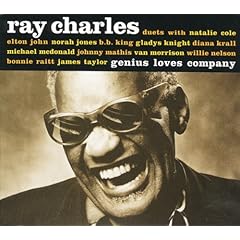
    Genius Loves Company (2004)

    1. Here We Go Again (with Norah Jones)
    2. Sweet Potato Pie (with James Taylor)
    3. You Don’t Know Me (with Diana Krall)
    4. Sorry Seems To Be The Hardest Word (with Elton John)
    5. Fever (with Natalie Cole)
    6. Do I Ever Cross your Mind? (with Bonnie Raitt)
    7. It Was A Very Good Year (with Willie Nelson)*
    8. Hey Girl (with Michael McDonald)
    9. Sinner’s Prayer (with B.B. King)
    10. Heaven Help Us All (with Gladys Knight)
    11. Over The Rainbow (with Johnny Mathis)
    12. Crazy Love (with Van Morrison)
    13. Unchain My Heart (with Take 6)
    14. Mary Ann (with Poncho Sanchez)
    "I’ve recorded with so many amazing artists in my career but never on a duets album all my own. I thought it was time to have some of the friends that I love and the artists that I admire come into my studio and sing with me live," explains Ray Charles on the genesis of Genius Loves Company, his final studio album.
    It won a basketful of Grammy Awards: Heaven Help Us All with Gladys Knight, won Best Gospel Performance. Here We Go Again with Norah Jones won Best Pop Vocal Collaboration and Record Of The Year. The album was voted Best Pop Vocal Album and Album Of The Year. One Grammy went to arranger Victor Vanacore for his arrangement on Over The Rainbow. The album went multi-platinum and hit #1 on the album charts in several countries.

    Co-stars & Personnel:
    B.B. King, Willie Nelson* - vocals, guitar; Bonnie Raitt - vocals, slide guitar; Norah Jones - vocals, piano; Michael McDonald - vocals, keyboards; Diana Krall, Elton John, James Taylor , Johnny Mathis, Van Morrison, Natalie Cole, Gladys Knight - vocals; Danny Jacob, George Marinelli, Jeff Mironov, Michael Landau, Michael Thompson, George Doering, Charles Fearing, Irv Kramer - guitar; Randy Waldman - piano, keyboards; Alan Pasqua - piano; Billy Preston - Hammond b-3 organ; Michael Bearden - keyboards; David Hayes, Abraham Laboriel, Sr., Trey Henry, Tom Fowler - bass guitar; James Gadson, Jim Keltner, Ray Brinker, Shawn Pelton - drums; Bashiri Johnson - percussion. Clarence McDonald arranged and played keyboards on Heaven Help Us All. For an unabridged personnel listing see Wikipedia.
    Slash claimed playing the original guitar parts on Sorry Seems To Be The Hardest Word, but "[...] after Ray died, the executive producer used a friend of his instead and took my part off, even though Ray thought I was more bluesy".

    Concord 2248-2, 2004-08.

    See these interesting pages for documentary information on some of the sessions.

    The AP Archives have an interview with Gladys Knight (from 2005), and some making of-footage from the recording of  Heaven Help Us All (from 2004).  

    Part 1 Making of:

    Part 2 Making of:


    This article from October 2004 in Mix by Blair Jackson presented an evocative making-of story:
    Producer John Burk explained, "[...] One of our main goals was to try to put him in the room live with the guest artists — the way he used to make records. He makes magic in the studio. And as I learned from working with him, perhaps his greatest gift is his ability to really communicate what a song is about and the emotion behind it. And when he works with another artist, he draws that out of them, as well."
    "[...] For the past 40 years, Charles mostly recorded at his RPM Studios [...] and the bulk of Genius Loves Company was cut there, using some of Charles' regular musicians and his longtime engineer, Terry Howard. Burk produced most of the album, but five tracks were helmed by Phil Ramone, who used Ed Thacker as his engineer. The three songs that were cut live with a full orchestra on the Warner Bros. L.A. scoring stage were co-produced by Howard and engineered by Bobby Fernandez. SACD pioneer Herb Waltl also earned a co-production credit for his assistance on the project, and it was he and Howard who facilitated Burk's initial meeting with Charles. The album was mixed by Al Schmitt at Capitol's Studio C on a Neve VR.
    Burk notes that having Ramone onboard for the project was particularly important. “Phil is clearly one of the greatest producers and engineers ever. He's also a friend and I consider him a mentor,” he says. “When I first talked to Ray about doing the project in his own studio, which has such a distinctive vibe and so much history, I wanted to bring Phil in right away because there's nobody better at making a room work. We ordered some baffling and did various other things to make the room sound better — Phil even brought in a huge garden umbrella to put over the drums because they were leaking all over the room. He put that in and taped in some foam and that really helped.”
    “It's a very bright room,” Ramone comments, “but I still didn't want to use a lot of isolation. It's decent-sized, maybe 40-by-30. It has a sort of late-'50s, early-'60s feeling, which is, of course, when he made some of his greatest music. Ray is very fussy about what he wants to hear, but he's also very cooperative and was open to suggestions.”
    It was Ramone who chose the vocal mic that Charles and his partners used. “We tried a couple of things at the outset,” he says. “We started with some Neumanns, but for some reason, they didn't feel right to me so we ended up using Audio-Technica 4060s. Once we settled on that, we stuck with it. I like to get things early; I'm a first-taker. I don't want to be changing mics on take five — if we get there — especially on someone like Ray Charles.” Ramone's vocal chain on Charles also included a Summit EQ and a Neve 1073 preamp. “I like to go with the simplistic best,” Ramone comments. “I like API and Avalon [preamps], too. I'm good with any of the top-of-the-line Class-A amps.” The project was recorded to Pro Tools, and Ramone notes that he used RPM's Quad 8 Virtuoso console mostly just for monitoring.
    Once Charles, the producers and the duet partners agreed on song choices, the work turned to picking appropriate arrangements. “It was so many different styles, you wanted to treat them differently,” Burk says. “There was a core band, which was pretty much Ray's guys — bass player Tom Fowler is probably the main one there — and then for drums, Ray wanted Ray Brinker, who has worked with [jazz singer] Tierney Sutton and others, and Randy Waldman did a lot of the piano work. Billy Preston was on the B3, and then there was a whole variety of guitar players.”
    As for the vocal arrangements, Ramone says, “Where I could prepare [the duet partners], I'd send them an idea of the arrangement, which would usually give a sense of where they might come in. But you learn your lesson fast with Ray, because he's such a great arranger himself and he's full of ideas and he always seems to have an opinion about how things should go. So you might come into a session thinking it's going to go one way, but with Ray, there's always the possibility that he's going to change it once you're in the room with him. If you're a singer and he feels you're stretching or straining and he doesn't like it, he'll change it. Or if he wants you to strain a little, you'll do it. He's so intuitive about how it should go.”
    “He has a very clear vision of what he wants,” Burk adds, “so a big part of the [producer's] job is to get that for him. A lot of the work is the dialog you have with him before the date. Then when you get into it, there's a lot of give and take, but now and then, it's going to go a certain way and that's all there is to it.
    “You don't tell Ray Charles how to sing,” he continues. “There were certain times where he'd say, ‘That's it. That's the take.’ Sometimes I'd ask him to try something and he'd say, ‘Okay.’ Other times, he'd say, ‘No.’ He knew when he got what he wanted, and he didn't do a lot of takes. Every now and then, he'd come back later and swap in a word or a line, but in general, that didn't work as well as the vocals he did in the moment with the other artists.”
    As is frequently the case with these sorts of all-star projects, scheduling turned out to be one of the biggest challenges; at the beginning, Charles' demanding agenda proved to be daunting. “He was still touring in June [2003], and he'd say, ‘I have three days — the eighth, the 14th and the 29th’ — so we'd scramble to see which artists we could come up with who were free,” Burk says. “When he stopped touring, he came into the office every day and the album became his main focus, so that actually made our job a little easier.”
    The first studio session, with B.B. King, came together in July 2003. “I could tell his hip was bothering him,” Burk says, “but he was an incredibly strong guy. [...] His attitude was, ‘I'm fine. I've got a little somethin' I'm dealing with. Don't worry about it. Let's go to work.’ So he might have an off-day. But he was a man of his word and a man of commitment. There was a day when he came to a session and he really wasn't feeling well, and I told him, ‘Ray, please don't ever do that again. I'm more than happy to reschedule.’ But his feeling was, ‘I said I was going to be there,’ so he showed up. He always showed up on time, ready to work.”
    For engineer Howard, who had worked with Charles for nearly two decades, he could tell that his boss was not well, “and I know B.B. was kind of shocked by how weak Ray seemed. But that session was one of my most memorable, because when you hear Ray singing, you really hear the pain in his voice, but when you hear B.B. coming in, you hear the strong shoulder of a friend that someone like Ray could lean against. Ray was already frail: When he talked, he sounded like an old person. But the fire in his soul was still there and once the song started, that frail voice left him and Ray Charles the star entered the building. He belted it out and we did it in just a couple or three takes.” [...]
    Another of Howard's favorites was the session with Bonnie Raitt, who Charles admired “for taking the time to really work on the song with Ray, changing a part a little here, changing the bridge this way. It was amazing to see two of the most talented people in the world crafting a song before your eyes. I know Ray really loved that track.” [...]
    Originally, Burk says, he had not planned on including orchestral tracks on the album, “but Ray had an idea about a song that he wanted to do with Willie Nelson [It Was A Very Good Year] with a full orchestra. And this is something Ray would do from time to time. He said, ‘I've already got the arrangement written and I've got to tell you, it's going to be awesome.’ He was so convicted, I said, ‘Okay, let's do it!’ before I heard the arrangement. The arranger, Victor Vanacore, does these amazing detailed demos of his charts, and when I heard it, I was knocked out, too.” One thing led to another, and soon Michael McDonald and Johnny Mathis were also cutting live with the orchestra at the Eastwood Scoring Stage, which is equipped with an SSL 9000J console. [...]
    By the late winter of 2004, Charles' health had declined precipitously and finding moments when he could work on the project became difficult. The knock-out duet with Elton John on John's “Sorry Seems to Be the Hardest Word,” cut last April, turned out to be the project's final recording.
    “I must admit, I was a little shocked at how frail he seemed when we got together in March,” Ramone says. “Compared to the way he was the previous fall, he seemed very, very fragile. He whispered to me at one point, ‘I'm really not well.’ I wanted to cry right there. People who were around were weeping in the control room, it was so emotional. But, of course, you always hope and believe that someone will get better, and I think we all believed that he would get better. I'll say this about him: He funneled every bit of energy he had into that performance. The chemistry between Ray and Elton was just incredible.”
    Though historically Charles was deeply involved in the mixing of his albums, his failing health kept him away from Schmitt's mixing sessions for the most part, and, as Burk notes, “At a certain point, he was not leaving his place much, so we set up an edNET system that would tap him into the studio so we could play the mixes for him. Even then there were times when he couldn't really give it his all. Once I got a CD ref to him, though, he played it nonstop in his car and I know he was happy with how it came out.”
    Charles succumbed to liver cancer on June 11, shortly after the album was mastered. “At the time, he wasn't really admitting to any of us how ill he was,” Burk says. “But you look back at some of the songs he chose and you start to wonder: ‘Was he trying to say something?’ ‘Was he trying to make some final statements?’ I think maybe he was.”
    Another article on MSNBC Today also revealed some important information on the genesis of the album, and Ray's last productive months (full story here):
    [...] “He seemed to be reminiscing a bit. I remember [Ray] said ‘If we had known we were going to live this long, we would have taken better care of ourselves,”’ [B.B.] King told The Associated Press during a recent interview. “I told him ‘You bet.”’
    It was the last time they would talk - or perform - together. [...]
    “Some of the songs I have been playing for years. Some were all-time favorites of mine that I’d never recorded. Others were songs by artists that I really liked,” Charles said before his death.
    [...T]he most emotional moment came between Charles and Elton John as the two recorded John’s Sorry Seems To Be The Hardest Word. It was the last song recorded for the album and the last one Charles ever sang, Burk said.
    “There wasn’t a dry eye in the recording booth,” Burk said. “It’s a very sad song, and there was just this emotion in the air.”
    [...] During the recording of the album, Charles’ health was deteriorating rapidly after undergoing hip surgery and being diagnosed with a failing liver.
    “He didn’t really say anything to anybody about it. He didn’t complain,” Burk said. “It never really became an obstacle.”
    In fact, during the recording sessions, Charles maintained his legendary focus. Known for demanding excellence, he held to that standard during the making of “Genius Loves Company.”
    “His professionalism and his attention and focus were amazing,” Raitt said. “I just think he was on it. That’s what musicians call it, being on it.”
    King, who broke down while singing at Charles funeral, said he hopes the album will cross generations and genres. [...] “You know, he’s one of a kind, doing what he did and how he did it,” he said. “Ray started before some of these kids were born. I hope they will take the memory of a great guy that has done so much great work.”
    The late Terry Howard, Ray Charles' longtime engineer, was heavily involved in producing this album (although he wasn't fully credited for that role). In an interesting interview he revealed:
    "[The Grammys] were for the Genius Loves Company that I worked on. I can talk a little bit about that because that was the last year of Ray's life. We had already signed a contract and everything was progressing to do this record. And one day when we did the B.B. King song Sinner's Prayer, Ray came off the road into the studio very sick. In all my years of working with Ray, I'd never seen him even with a cold. I knew before the doctors said; when you are close with somebody, you can tell that something is wrong. I knew at the time (although I was hoping it wasn't going to be) that this might be Ray's last record. Everybody involved decided that it was instrumental that we keep Ray's spirits up and keep this record going.
    It took a lot of energy for me, because after that, starting in about August, I was with Ray on a daily basis. Normally I would work with Ray about three or four days out of the week, three to six hours a day. At that point I was with him from the time he got to the studio at about eleven in the morning to the time he left at about six at night. He would be taking care of his health, and I would be in the control room going through songs and putting rough mixes together so I could play parts to him. Ray would choose a song and I would go sit down with him, and we would decide what arranger to use and what musicians to use. Ray and I would go over the song and decide what key the song would sound best in. This is something I would learn from Ray. There are two things that are very important things to do in a song. You don't set the key, because that is the key that the person can sing in. Each key has a different sound. If you go up and transpose, you'll notice that one key might sound more melodic than another one and one might sound sadder. He would say, 'Now which one sounds right for this song?' We would pick a step or two in either direction of the key the accompanying artist was singing in.
    Ray taught me that tempo is very important. Sometimes we would sit there for an hour and then come in the next day and rethink it again and sit there with the metronome and count it off and play a part of the song and he would try out some vocal phrasing, and we would try different things till we felt that the emotion Ray wanted was coming through the music. Sometimes we would argue with people at the label who wanted the tempo speeded up, and you don't change Ray's decision on tempo - that's the emotion of the song." 
    A limited edition of this CD (Concord/Liberty/EMI 7243 8 75873 0 4) contains documentary footage of recording sessions (probably identical to the clips above), the Session Projects interview with Ray Charles from 1985, and an announcement of the film Ray.

    In the UK record company EMI produced a promotional CD containing interviews with 5 of Ray's duet partners - Bonnie Raitt, Elton John, Michael McDonald, Norah Jones and Willie Nelson - recounting their experience of Charles; be it working with him or their discovery of his music.

    The original album's contents were re-released in 3 variant packages (Concord, September - December 2014; ASIN B00MY5AKEA, B00MWZIASS, B00MY5AK1I) - one of them in (2-LP, 45RPM, 180-gram) vinyl*. One version is packaged with the film Ray; including "interviews with guest artists from then and now"; and a "new expanded booklet with updated liner notes and photos".

    * The press release also promised a download voucher for two bonus tracks, but it's not clear if these are the known extra tracks that are part of all variants (including the 2004 pack), or if they are entirely new 'give aways'.

    Promo 2014 release (short):

    Promo 2014 release (longer):


    AP footage:

    * Mid March 2004 Willie Nelson postponed one of his concerts to make it to the recording session with Ray: "Willie has changed to Friday the 26th at 8:00p.m. He has an emergency recording with Ray Charles as Ray is not long for the world according to the production people that just called us."


    See clip here.

    Thanks For Bringing Love Around Again (2002)

    1. What'd I Say ["new arrangement"]
    2. Can You Love Me Like That (with The Raelettes)
    3. How Did You Feel The Morning After
    4. I Love You More Than I Ever Have
    5. Really Got A Hold On Me
    6. Thanks For Bringing Love Around Again
    7. Save Your Lovin' Just For Me
    8. I Just Can't Get Enough Of You
    9. Ensemble (with Ginie Line)
    10. New Orleans
    11. Mr. Creole
    12. Mother 
    On this album Ray used a variety of synthesizers for backing strings, horns and percussion. For the occasion he relaunched his Crossover label. Staff songwriter Billy Osborne penned most of the tunes and prepared the basic rhythm and synth tracks. This was the last album that Ray produced - he picked the tunes and oversaw the arrangements. He had been recording, mixing and remixing the tracks on this album (also filling in his own backing vocals on a number of tracks) since 1997.
    Ensemble was a studio version of a song he originally performed live with Ginie Line on the French Star Academy show, in 2002*. The new arrangement of What'd I Say was originally produced for a Japanese commercial. Mr. Creole was written by Renald Richard, the trumpet player who led Ray's first band in 1954. Mother was a moving final tribute to his own mother; he performed it as a personal statement: "I surely still do miss my Mama, doesn't matter how old I grow... no one can take my Mother's love from me." By the end a chorus of Rays sings a mournful a cappella.

    * For an odd 2010 version of this duet with Lara Fabian, read this post.

    In this minidoc Billy Osbornelooked back on his collaboration with Ray:


    Personnel:
    Brenda Lee Egar (vocals); Phillipe Falcao (acoustic & electric guitars); Paul Jackson Jr, Marlo Henderson (guitar); Larry Williams (saxophone); Gary Grant, Jerry Hey (trumpet); Randy Kerber (keyboards); Oliver Monteils (drums); Mike Fisher (percussion); The Waters, Katrina Harper Cooke (background vocals).
    Recorded at Ouistiti Studios and Plus XXX Studios, Paris, France; RPM International, Los Angeles, California; Lighthouse Recording Studio, Studio City, California.

    Crossover 4000, 2002-05.


    22 February 2010

    Strong Love Affair (1996)

    1. All She Wants To Do Is Love Me
    2. Say No More
    3. No Time To Waste Time
    4. Angelina
    5. Tell What You Want Me To Do
    6. Strong Love Affair
    7. Everybody's Handsome Child
    8. Out Of My Life
    9. The Fever
    10. Separate Ways
    11. I Need A Good Woman Bad
    12. If You Give Me Your Heart (with Peggy Scott-Adams)
    Once again without a record label, Ray collaborated on this  album with Jean-Pierre Grosz, a French producer. Grosz send songs for Ray to select, recorded the instrumentals in Paris, and then send them back to Ray for the vocals. In the end Quincy Jones released the album on his Qwest label, distributed by Warner Bros.

    Oddly*, the Strong Love Affair album was initially released in Italy one year prior to the U.S. release, in 1995. Cf. this offer on Ebay. Also in Italy, the album got a second re-release in 2000 under the overall title Imagine, in fact the title of the bonus track (there was also a second bonus: the 1989 duet with Dee Dee Bridgewater, Precious Thing). For the production and release history of Imagine also see this post.
    * Information kindly shared by Joël Dufour.

    Personnel: Knut Koppang - piano; Don Snowkey - boards; Richard Niles - keyboards, arranger; Thierry Elies - organ, piano; Emilio Castillo, Molly Ducantenor - saxophone; Nigel Hitchcock - alto saxophone; Stephen Doc Kupka - baritone saxophone; David Mann - tenor saxophone, alto saxophone; Sid Gauld, Lee Thornburg, Paul Spong - trumpet; Greg Adams - trumpet, arranger; Nell Sidnell - trombone; Elvind Aarset, Tim Cansfield, Herve Krief, Nguyen Le, Basil Leroux, Yves N'Joke, Phil Palmer, Mark Sullivan, Patrice Tison - guitar; Brad Lang - bass; Kjetil Bjerkestrand - bass, keyboards, arranger; Phil Spalding - bass, vocals; Jean-Louis Odin, Bjorg Vaernes - cello; André Ceccarelli, Ian Thomas - drums; Luis Jardim, Marc Chantereau - percussion; Nora Tallsdal - viola; Berir Vaernes, Oyvor Volle - violin; Stevie Lange, Sylvia Mason-James, Maggy Ryder, John Savannah, C.H. Thompson - vocals.

    Qwest Records  9362-46107-2/Warner Bros. 46107, January 1996.


    My World (1993)

    1. My World
    2. A Song For You
    3. None Of Us Are Free (with Eric Clapton)
    4. So Help Me God
    5. Let Me Take Over
    6. One Drop Of Love
    7. If I Could
    8. Love Has A Mind Of Its Own
    9. I'll Be There
    10. Still Crazy After All These Years 
    11. More Love Than Ordinary (only French release)*
    For this album Warner's Mo Ostin brought in veteran producer Richard Perry. The album was recorded at Cherokee, House of Soul, Capitol, Summa, Studio Ultimo, Clinton Recording Studio B, and Peter Rafelson Studio. Song For You won a Grammy Award for Best Rhythm & Blues Vocal Performance. About Paul Simon's Still Crazy After All These Years Ray told writer David Ritz, "Still Crazy fit me fine, especially the part that says, ‘I'm not the kind of man who tends to socialize/I seem to lean on old familiar ways.' That's me."
    *The French edition of the CD had More Love Than Ordinary as a bonus track (cf. this).

    Session musicians*: Billy Preston, Eric Clapton, Mavis Staples. Personnel: Jimmy Cox, Greg Phillinganes - piano; Dan Farrow - keyboards; Jud J. Friedman - keyboards, string synths; Billy Preston - organ, clavinets, hammond B-3; Guy Moon, Randy Kerber - synthesizers; Steve Lindsey - synths, wurlitzer, synth horns; Doug Norwine, Lee Thornburg - horn; Eric Clapton, James Harrah, Paul Jackson Jr, Tommy Organ - guitar; Randy Waldman - guitar synth; Jimmy Johnson, Abe Laboriel, Lee Sklar - bass; Chuckii Booker, Khris Kellow, Tom Snow - synth bass; Shaun Labelle - bass, synth bass, clavinet, drum progamming; Paulinho da Costa - conga, tamborine; Donny Nguyen - drum & percuccion programming; John Blackjack Levy - drum & percuccion programming, synth horns; Bob Chiarelli - drum programming; Vinnie Colaiuta, Steve Gadd, Jeff Porcaro - drums; Enrico De Paoli - percussion programming; Bob Thiele Jr - string synths; Maxi Anderson, Alex Brown, Joey Diggs, Lisa Frazier, Karen Grant, Portia Griffin, Maxanne Lewis, Jean McClain, Arnold McCuller, Phil Perry, Valerie Pinkston-Mayo, June Pointer, Phil Royal, Brenda Russell, Alfie Silas, Mavis Staples, Rosie Stone, Carmen Twittie, Billy Valentine, Tata Vega, Sharon Wallace, Oren Waters, Yvonne Williams, Monalisa Young, Terry Young - vocals; Carl King - arranger, drums, percussion, synthesizer programming; Barry Mann - arranger, synthesizer; Jeremy Lubbock, Richard Perry - arranger.

    CD: Warner Bros 26735, 1993-03.
    LP: Warner Bros WE 833.

    *For details per track see this